

After crying "wolf" 4 times, Trump turned the negotiation deadline into a product


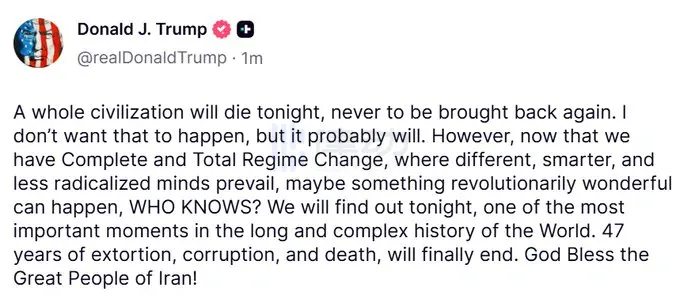
At 8 a.m. on April 8th Beijing Time, Trump wrote on Truth Social the line that was repeatedly quoted by major news outlets: "An entire civilization will disappear tonight, never to return." Almost at the same hour, on the New York after-hours trading screen, Brent crude oil plummeted from $109.27 to $107, as if a reset button had been pressed.
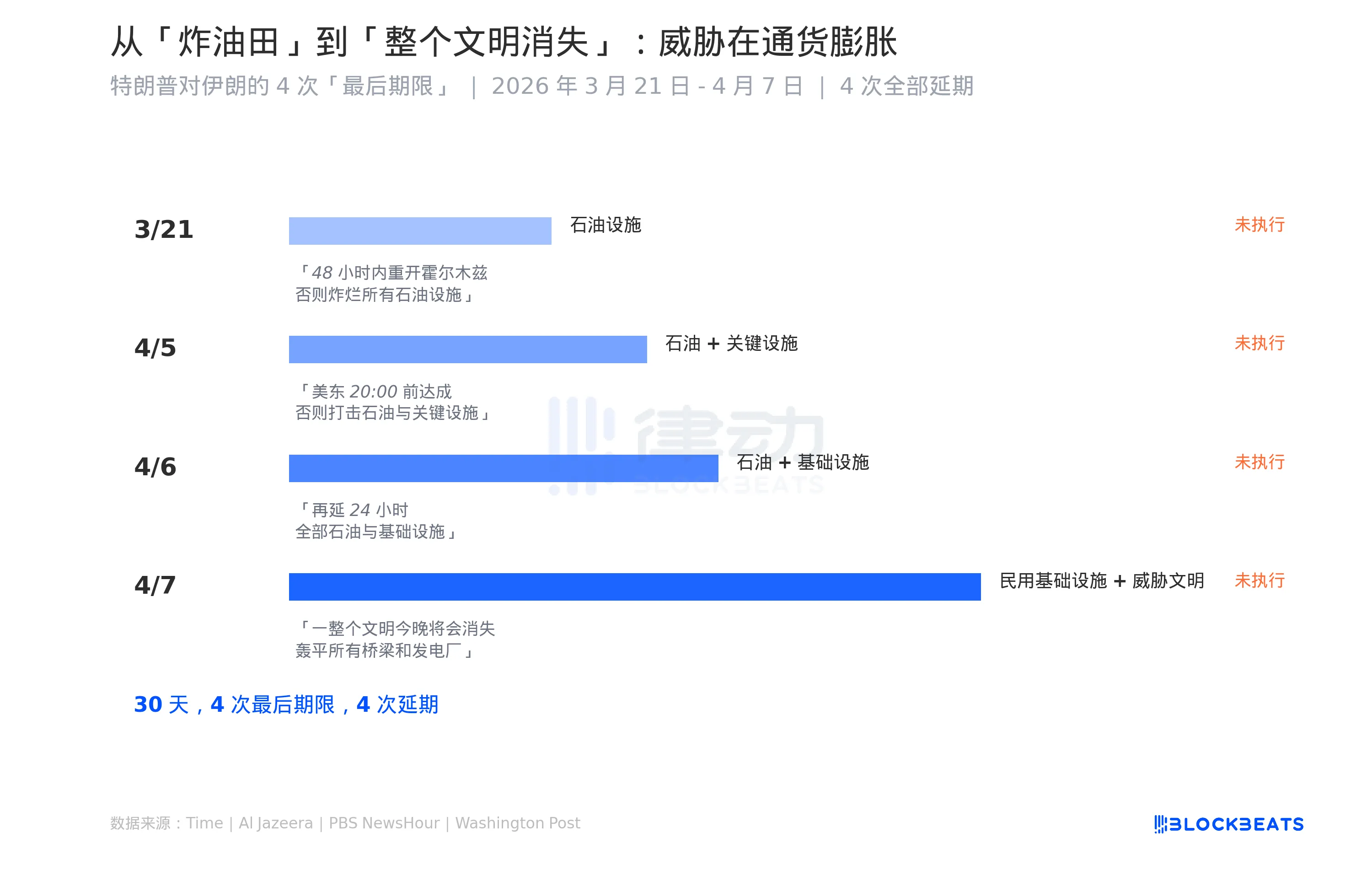
This is Trump's fourth "final warning" to Iran in the past 30 days, and the fourth time he has retracted it at the deadline moment.
On March 21, he first threatened to "reopen the Strait of Hormuz within 48 hours or blow up all oil facilities," but didn't;
On April 5, he extended it until 8 p.m., but didn't;
On April 6, another 24-hour extension, but didn't;
On April 7 at 8 p.m. ET, it escalated to "flatten all bridges and power plants," accompanied by the phrase "an entire civilization will disappear," yet still didn't.
Instead, there was a two-week ceasefire agreement and a flight ticket to Islamabad on Friday. Iranian Foreign Minister Aragchi wrote on X: "Over the next two weeks, safe passage through the Strait of Hormuz will be achieved through coordination with the Iranian armed forces and considering technological limitations." Tehran simultaneously declared "victory."
Four deadlines, four extensions. This event itself constitutes one of the most worthy phenomena in the current Middle East to be dissected. The public opinion is currently mainly discussing this night on two inertial tracks, one treating it as another diplomatic farce, crying "wolf" for the fourth time, and the other seeing it as a trading opportunity in the oil market, watching Brent oscillate between 109 and 107. Both perspectives are not wrong, but they both evade a sharper question: If the final warning fails every time, then who is it really deterring?
The answer may be that it was never about deterrence from the start.
Deterrence has one basic physical property: signal credibility decays over time. You say "we'll strike tonight" once and don't, next time the market discounts it, the third time allies doubt it, the fourth time the enemy outright ignores it. But in the past 30 days, the opposite has happened: every time the deadline arrives and no strike occurs, the rhetoric of the next threat becomes heavier, market reactions become more intense, and the chips on the negotiation table pile up even higher. From "blow up the oil fields in 48 hours" to "flatten bridges and power plants" to "an entire civilization will disappear," the threat itself is undergoing inflation.
Instead of using deadlines to pressure Iran to make concessions, Trump seems to be using deadlines to set the pace for the international news cycle and the global energy market. The deadline itself is the product, not the means. Its purpose is not to change Tehran's behavior, but to impose a predictable rhythm on the entire geo-financial system, making hedge funds, oil traders, Middle Eastern allies, Israel, and even Iran itself move to his countdown. Each time the countdown hits zero, it is not a failure but a press of the reset button to enter the next cycle.
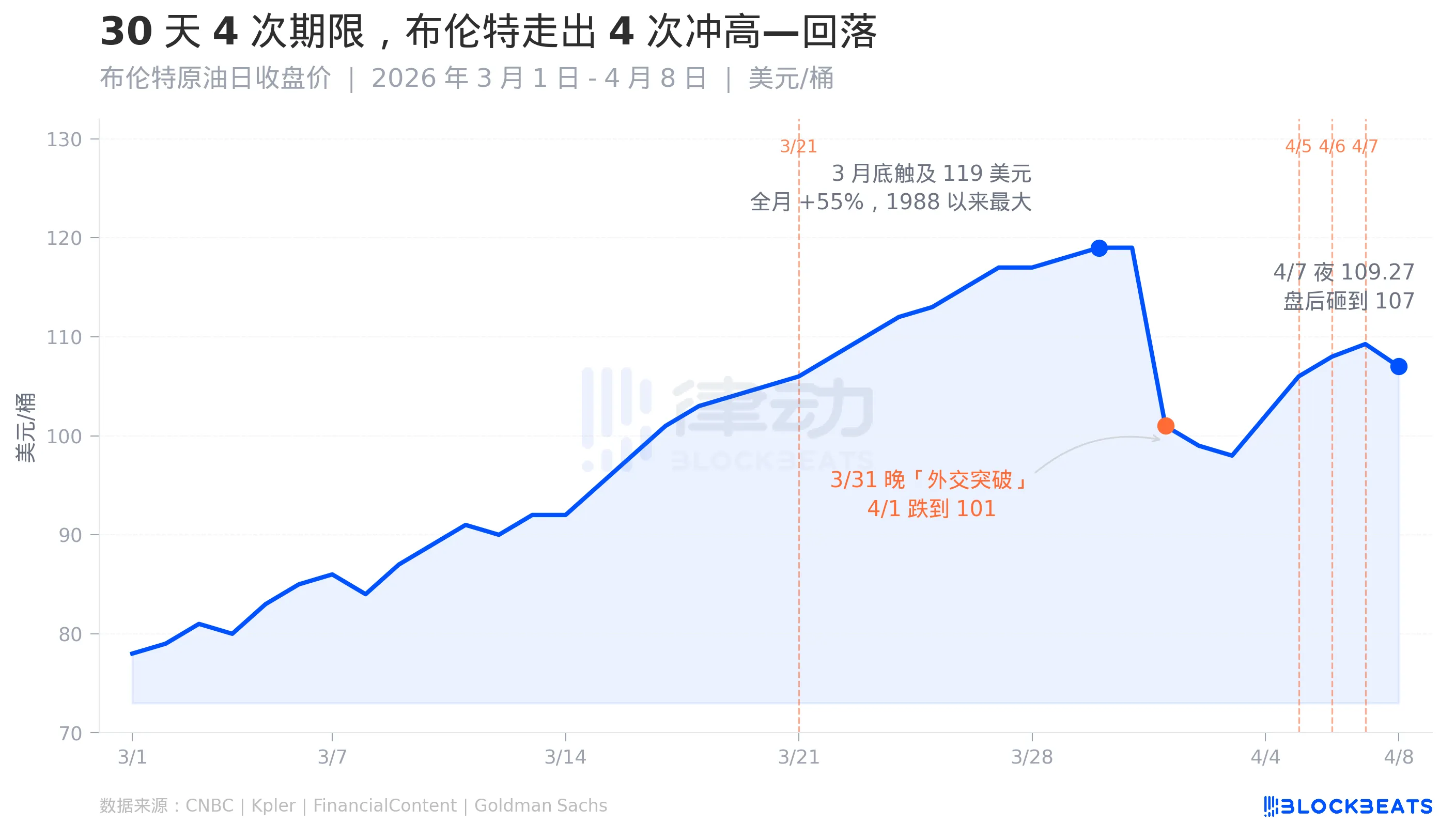
Throughout March, Brent crude oil rose by about 55%, marking the largest monthly gain since the birth of this contract in 1988. Goldman Sachs estimated that at least $14 of this increase was pure "war premium," corresponding to the tail risk of a complete closure of the Strait of Hormuz. Prices approached $120 by the end of March, then rapidly fell back to around $101 at the opening on April 1 following a "diplomatic breakthrough" late on March 31.
Subsequently, Trump's first "48-hour ultimatum" pushed the price back up, with three surges on April 5, 6, and 7, each forming a high before the respective deadlines. On April 7, Brent touched $111.51 and WTI touched $115.86 during intraday trading. After Trump announced an extension at the deadline, Brent quickly fell back to $107 in after-hours trading. Surge, fall back, surge, fall back—this waveform has repeated more than once in the past 6 weeks.
This pattern of behavior did not emerge in 2026. Its prototype was fully staged 7 years ago.
On June 20, 2019, the Iranian Revolutionary Guard shot down a U.S. "Global Hawk" drone over the Strait of Hormuz. Trump received a military briefing at the White House and approved precision strikes on three Iranian radar and missile sites. Aircraft were in the air, and ships were in position. Using his own words later, the U.S. military was "cocked and loaded." Then, 10 minutes before the strike, he asked one final question: How many people will die? The general's answer was 150. Trump said that number was disproportionate to downing a drone and called off the strike.
It took the world 48 hours to digest this event. The hawks criticized his lack of resolve, the doves praised his restrained rationality, and the media debated whether those 10 minutes were real or not. But all these reactions treated the event itself as a one-time emotional decision, without realizing it was a methodology, a way of manipulating adversaries' expectations and domestic political clocks using a cycle of "threat—retraction—repricing."
Seven years later, that methodology was reused in a real battlefield that had been burned by war for six weeks, Brent had surged to $120, and 20% of global oil throughput was still semi-closed. The only difference was the scale and pace: a single withdrawal back then, four withdrawals this year; the target back then was a drone, this year it's a whole civilization.
Another equally apt image comes from Northeast Asia. In August 2017, Trump warned North Korea of "fire and fury like the world has never seen," escalating in September of the same year to "Rocket Man" and "total destruction." Then, in March 2018, he abruptly agreed to meet Kim Jong-un, shook hands at the Singapore summit in June, met in Hanoi in February 2019, then at Panmunjom in June 2019, where they shook hands at the military demarcation line, with Trump stepping over that concrete line to become the first sitting U.S. president to set foot in North Korea. From fire and fury to a historic handshake, only 10 months elapsed.
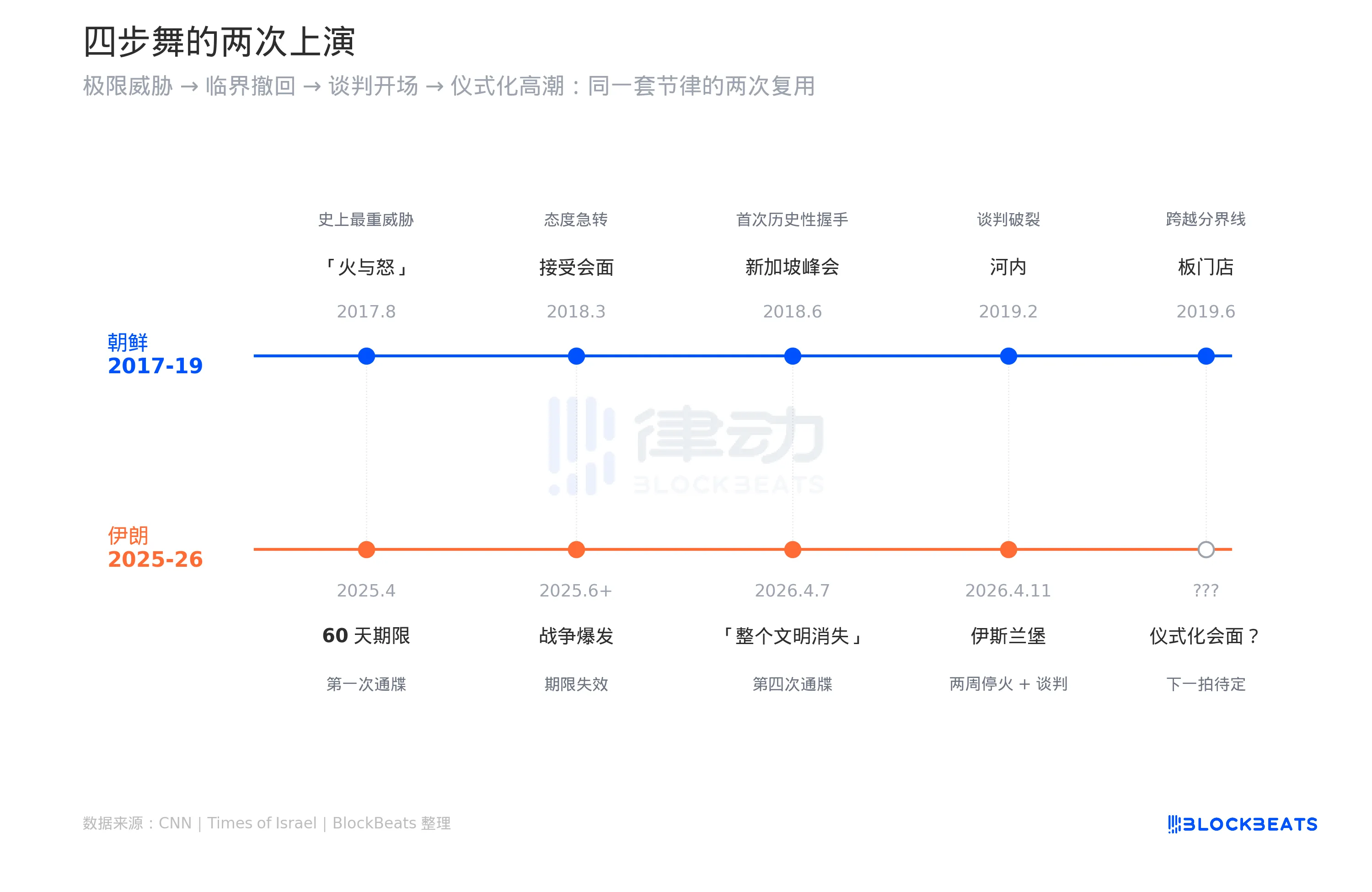
There was no war, no substantial breakthrough in sanctions, not even any substantive reduction in North Korea's nuclear capabilities. What we saw was a four-step dance reused in full twice: maximum threat, brinkmanship, opening negotiations, and a ritualistic climax. Each step in between was treated as a standalone event by the media and the markets, with each step's pricing being reset by the next.
Where is Iran in this dance today? The answer is: a two-week ceasefire + talks in Islamabad ≈ the eve of the Singapore summit back then. If you were to overlay the North Korean nuclear timeline here, the next step would be a highly anticipated ceremonial meeting, possibly in Islamabad, perhaps in Muscat, or even symbolically at a border like Panmunjom. After the ceremony, substantive progress would be close to zero, but global attention, oil volatility, and the U.S. domestic political agenda would all be reset to the next countdown.
You may also like

The arrival of the Web 3.0 era: A review of Hong Kong court rulings on digital assets

Track Markets At a Glance: New WEEX Price Widgets for iOS & Android
To streamline your market data access, WEEX has officially launched "Market Watchlist" desktop widgets

The billion-dollar lesson: The focus of DeFi security is shifting from code to operational governance

A Brief Analysis of Stablecoin Licenses and On-Chain Funding
BVNK Founder: Three Stages of Stablecoin Development

The truth about Trump's son's Bitcoin game: he made a staggering $100 million while retail investors lost $500 million

What Is Futures Trading? Hours, Platforms, and How to Start Trade Futures(2026 Guide)
Learn how to start futures trading, understand trading hours, and choose the best futures trading platform. Includes real data, strategies, and ways to maximize returns with rebates.

The Rise of Composable RWA

MAGA Up 350% in 24 Hours, PEPE Up 46% in One Day: Which Memecoins Are Next in 2026?
MAGA +350% in 24hrs. PEPE +46% in one day. RAVE +4,500% then -90%. In 2026's memecoin market, the gains are real. So are the traps? Here's how to tell the difference before you buy.

RCD Espanyol vs Real Madrid: Can the Pericos Delay the Inevitable?
RCD Espanyol vs Real Madrid lineups, standings, and stats for May 3, 2026. Real Madrid visits RCDE Stadium as Barcelona closes in on the LALIGA title. Full preview inside.
MegaETH goes live with an FDV exceeding 2 billion USD. Which ecological projects are worth paying attention to?

Dialogue with "Wood Sister" Cathie Wood: The next bull market is about to arrive
Can prediction markets win the competition for perpetual contracts?

Who is trading on Trade.xyz?

Binance quietly placed a bet on a leading large model company

Best Crypto Discord Server 2026: Why Jacob’s Crypto Clan Is Gaining Massive Attention
Jacob’s Crypto Clan has grown into one of the most active crypto Discord communities, with over 45K members and continuing to expand. This rapid growth reflects strong demand for structured trading insights and real-time collaboration.

Tom Lee Buying ETH: Why Wall Street’s Loudest Ethereum Bull Keeps Doubling Down
Tom Lee keeps buying ETH through every dip, every drawdown, and every moment of market doubt. Inside the strategy that's turning Ethereum into a treasury asset — and what it signals for the rest of the market.

Stripe Sessions 2026: AI Agent, Global Payments, and Invisible Crypto Infrastructure
The arrival of the Web 3.0 era: A review of Hong Kong court rulings on digital assets
Track Markets At a Glance: New WEEX Price Widgets for iOS & Android
To streamline your market data access, WEEX has officially launched "Market Watchlist" desktop widgets
The billion-dollar lesson: The focus of DeFi security is shifting from code to operational governance
A Brief Analysis of Stablecoin Licenses and On-Chain Funding
BVNK Founder: Three Stages of Stablecoin Development
The truth about Trump's son's Bitcoin game: he made a staggering $100 million while retail investors lost $500 million


