
- Buy Crypto
- Markets
 Futures
- Spot
- Copy Trade
- Earn
- More
AI Computing Power Arms Race Intensifies: This Startup Aims to Mine Bitcoin in Space

Original Title: "After Just Launching NVIDIA AI Servers Into Space, This Space Startup Sets Its Sights on btc-42">Bitcoin Mining"
Original Author: Nancy, PANews
The next battlefield for AI has extended into space, gradually becoming a new direction in the business narrative.
Following the successful launch of the first space-based AI server, a space computing startup recently announced plans to take Bitcoin mining to outer space.
Plan to Mine Bitcoin in Space This Year, Symbolism Potentially Greater Than Actual Value
Having passed through the first half of chip and model competition, the competition for AI computing power has quietly shifted to the struggle for energy. Electricity, as a core resource in this competition, is rapidly becoming a scarce resource in the global computing power race. This transformation has not only changed the industry landscape but also directly reshaped the cost structure of the Bitcoin mining industry.
In particular, formerly steady Bitcoin miners have now turned to the AI computing race. Behind this transformation are not only the survival pressure brought by Bitcoin halving, but also the profit squeeze brought by intensified competition and rising energy costs, as well as the tremendous opportunities brought by the AI narrative.
As Bitcoin mining profitability is squeezed by global energy competition, Starcloud has put forward a bold plan to move Bitcoin mining to space.
In a recent interview with HyperChange, Starcloud CEO Philip Johnston revealed that the company is currently mainly focused on its existing space computing business but also has plans for Bitcoin mining. Starcloud will deploy some ASIC hardware designed for Bitcoin mining on the Starcloud-2 satellite scheduled to launch later in 2026. If successful, Starcloud will become the world's first spacecraft to mine Bitcoin in space.
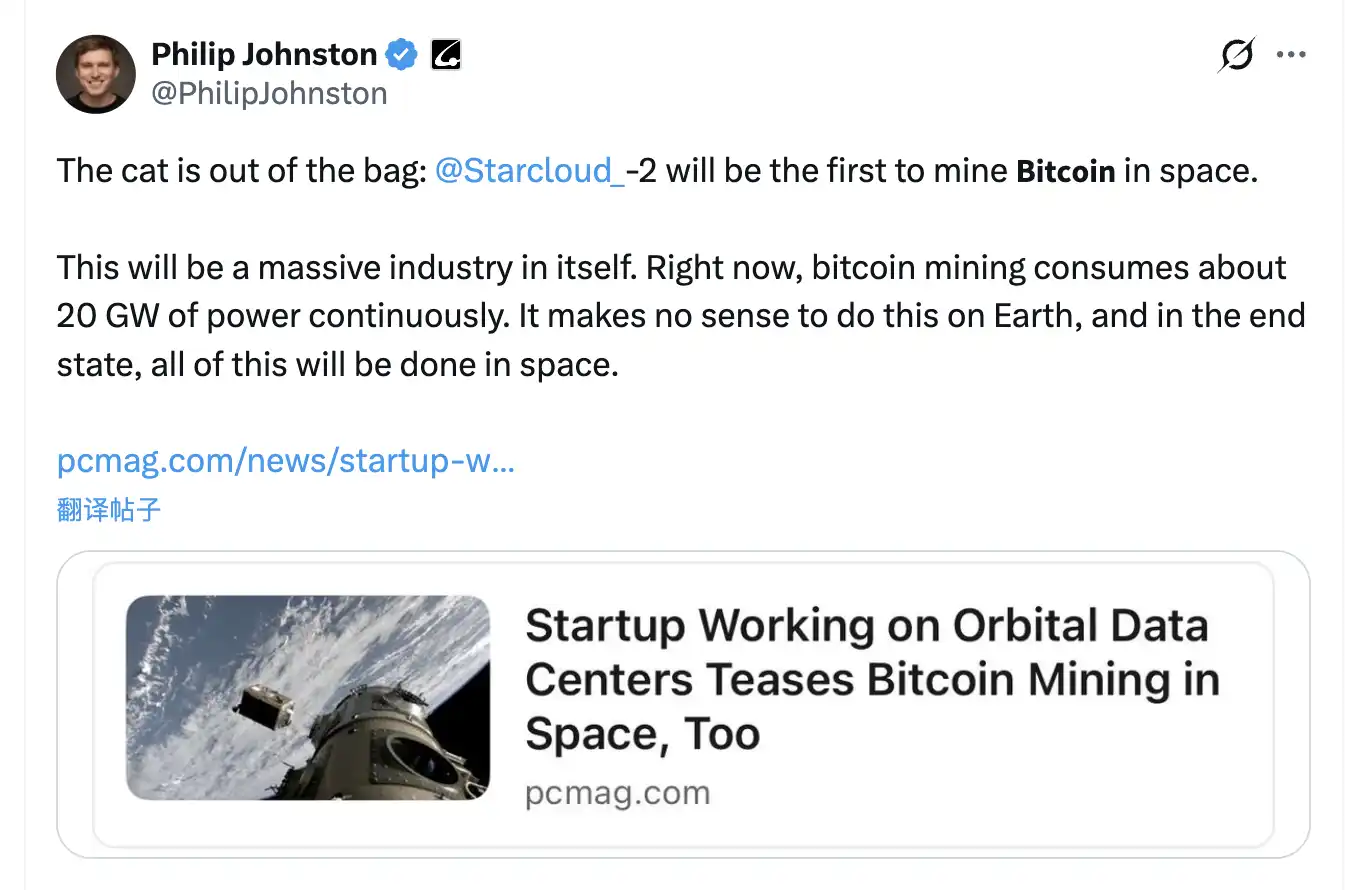
Johnston believes that space has multiple natural advantages over Earth. First, space has an infinite and continuous solar energy supply, which is more stable and lower in cost than renewable energy sources on Earth; at the same time, the superior environment in space, although characterized by extreme temperature differences and radiation, can significantly reduce hardware heat dissipation, lowering cooling costs and equipment maintenance burden. Most importantly, Bitcoin mining in space can bypass the Earth's increasingly tight energy bottlenecks, grid restrictions, and regulatory pressures. Currently, about 20GW of power on Earth is used for Bitcoin mining, a large-scale power consumption that is no longer feasible on the ground. In space, using solar energy to obtain cheap energy will provide a completely new solution for Bitcoin mining.
Johnston also pointed out that the cost of Bitcoin mining equipment is typically between $600 and several thousand dollars, much lower than Nvidia's enterprise-grade GPUs (which usually cost over $30,000). This makes the economic viability of space Bitcoin mining highly attractive.
Starcloud sees space-based Bitcoin mining as a form of "business of the future," leveraging solar power in space to obtain cheap energy. The company openly states that this is one of the reasons it and other companies (including SpaceX) are building data centers in space. Space mining can not only significantly reduce costs but also provide a new resource acquisition model for the global computing power market.
The concept of space mining is not new. Last year, Intercosmic Energy also mentioned that it was researching Bitcoin mining in space.
However, space-based Bitcoin mining still faces several challenges. Johnston also acknowledged that the economic viability of Bitcoin mining in space remains unstable. Currently, Bitcoin ASIC devices can run on any cheap energy source, but as new devices are continuously introduced, the profitability of mining equipment may rapidly decline.
Moreover, although launch costs are decreasing year by year, sending hardware into space is still a costly endeavor. Compared to ground-based mining facilities, the startup and maintenance costs of space mining are still high, including expenses for launch, spacecraft integration, satellite communication, equipment upgrades, etc.
Even more challenging is the extremely harsh space environment's demands on hardware. ASIC devices for Bitcoin mining need to operate stably under extreme conditions such as high radiation, temperature variations, posing a severe test to the performance and lifespan of the equipment. Maintenance and upgrades of the equipment will also become a major issue because once a failure occurs, the cost and difficulty of repairing and replacing hardware will significantly increase.
Previously, many crypto organizations have been exploring bringing blockchain business into space. For example, the veteran company Blockstream in the Bitcoin community has, since 2017, leased multiple geosynchronous orbit satellites to globally broadcast Bitcoin blockchain data for free, so even in the event of large-scale network outages on Earth (such as natural disasters or man-made blockades), as long as you have a small satellite dish (receiver), you can synchronize the Bitcoin ledger and complete transactions. SpaceChain installed the first commercial Ethereum node on the International Space Station (ISS) as early as 2019. At the beginning of this year, a new project focusing on space business, Spacecoin, also attracted market attention by using a satellite network to achieve cryptocurrency payment settlement.
Therefore, in space mining, the short-term investment may far outweigh the returns, and currently, it is more symbolic in nature, or rather a narrative tool used by this startup to attract market attention.
For the First Time in Human History, an NVIDIA AI Server has been Launched into Space
Founded in 2024, Starcloud, formerly known as Lumen Orbit, has emerged in the global tech scene as one of the earliest companies to propose building data centers in space.
As a member of the NVIDIA Accelerator Program and a graduate of Y Combinator and Google Cloud's incubator program, Starcloud is not simply moving data centers to space; its goal is to leverage the unique resources in space to construct infrastructure capable of supporting AI computation and large-scale computing.
Currently, Starcloud has secured at least $21 million in funding, with backing from notable investors such as NFX, Y Combinator, FUSE, Soma Capital, a16z, and Sequoia Capital.
Starcloud has established itself in the space AI computing arena. In November of last year, Starcloud achieved the first-ever space orbit large-scale model training. Through a SpaceX Falcon 9 rocket launch of its own Starcloud-1 satellite, it sent an NVIDIA H100 GPU into Earth's orbit and successfully ran Google's open-source AI large model, Gemma, sending the first message from space to Earth: "Hello, people of Earth!"

At that time, Philip Johnston stated that space AI is not just a gimmick; the company aims to achieve an orbital data center with energy costs 10 times lower than ground-based data centers.
Having achieved initial milestones, Starcloud's ambitions did not stop there. Recently, the company submitted an application to the FCC to deploy a massive constellation of 88,000 satellites to build a distributed, space-based AI training and cloud computing platform. However, turning this vision into reality poses significant challenges, from the scale of funding, regulatory approvals, launch capacity, orbital resource allocation to operational sustainability. This is not just a business race but a systematic engineering challenge, with each step full of uncertainty and complexity.
Beyond Starcloud, as the AI industry's demand for computing resources continues to grow, more and more tech companies are seeking new sources of computing power, with space gradually becoming the focal point of this competition. For example, Google officially launched the Sunseeker project at the end of last year, announcing the deployment of in-house TPU AI chips into space to build a solar-powered space data center prototype. Musk's SpaceX recently submitted an application to deploy 1 million satellites in Earth's orbit to build an orbital data center; and most recently, data storage and disaster recovery company Lonestar and semiconductor and storage company Phiso launched a set of data center infrastructure bound for the moon through a SpaceX rocket.
As the concept of space data centers transitions from science fiction to reality, a new arms race for infrastructure is unfolding. According to Musk's prediction, in five years, the annual additional AI computing power in space will reach several hundred gigawatts; the annual AI computing power deployed into space will surpass the cumulative total of all AI on Earth.
By then, the main battleground of the AI computing power competition will truly shift to space. In the coming years, we will see more commercial exploration and technological innovation, with space mining perhaps just being one stepping stone in this wave.
You may also like

Bitcoin Price Stalls in the Face of Stubborn $72K Barrier
Key Takeaways: Bitcoin’s price struggles to surpass the $72,000 resistance level, facing repeated rejections. Increased supply at loss…

Bitcoin Price Confronts ‘Challenging’ Cycle Phase After Failing $72K Resistance
Key Takeaways: Bitcoin remains in a tight range after failing to surpass the $72,000 resistance. Increased supply in…

Bitcoin and Gold: Examining the Shift in ETF Flows
Key Takeaways: Bitcoin ETFs recently saw an increased inflow of $273 million over 30 days ending March 6,…

Bitcoin Leads, Altcoin Indicators Hit Lows: Are We Entering an Altseason?
Key Takeaways: Bitcoin’s price resurgence to $71,000 indicates a potential market stabilization. TOTAL2, a metric excluding Bitcoin, aligns…

XRP Price Chart Mirrors 2017 Rally Setup: Implications for Future Movements
Key Takeaways: XRP’s current weekly chart echoes the 2017 cycle low, suggesting the potential for a 1,577% surge.…
Bitcoin Order Book Imbalance: Can $70K Support Hold?
Key Takeaways: Bitcoin’s sell-side liquidity is at a two-month high, reminiscent of the January 2026 scenario. Within 5%…

When Buying Bitcoin, Don’t Expect Immediate Profits: A Three-Year Outlook
Key Takeaways: Bitcoin holders benefit most significantly after a three-year period, observing substantial gains post-volatility. Investors who bought…

DOJ Investigates Binance’s Alleged Role in Iran Sanctions Evasion
Key Takeaways: The U.S. Department of Justice (DOJ) is scrutinizing Binance over possible involvement in US sanctions evasion…

Ether Rides High at $2K: Traders Eye Overhead Short Liquidity
Key Takeaways: Ether’s trading volume surges past $2,000 driven by intensified derivatives action. A fresh net inflow of…

South Korea Offloads $21.5 Million in Bitcoin Reclaimed After Custody Breach
Key Takeaways: South Korean authorities recovered and liquidated 320.8 Bitcoin following a phishing incident. The sale took place…
BitMEX Co-Founder Arthur Hayes Hesitant on Bitcoin Investment Amid Fed’s Firm Monetary Policy
Key Takeaways: Arthur Hayes, the co-founder of BitMEX, is currently holding off on investing in Bitcoin, waiting for…

SlowMist Unveils Web3 Security Shield for Autonomous AI Agents
Key Takeaways: SlowMist has designed a five-layer security system for Web3 AI agents to mitigate risks associated with…

Ripple Eyes Australian Financial License Through Strategic Acquisition
Key Takeaways: Ripple intends to obtain an Australian Financial Services License (AFSL) by acquiring BC Payments Australia. The…

VanEck Crypto ETFs Now Accessible Through Basic Capital’s 401(k) Platform
Key Takeaways: VanEck’s digital asset ETFs are now available to U.S. 401(k) holders via Basic Capital, marking a…
India Detains Darwin Labs Co-Founder amid GainBitcoin Investigation
Key Takeaways: India’s CBI has arrested Ayush Varshney, co-founder of Darwin Labs, for his involvement in the GainBitcoin…

Strive Commits $50M to Strategy’s STRC Preferred Stock
Key Takeaways: Strive Asset Management invests $50 million in STRC, a digital credit instrument connected to Strategy’s Bitcoin…

ECB Launches Appia Project to Revolutionize Tokenized Markets
Key Takeaways: The European Central Bank (ECB) has introduced the Appia project to transform Europe’s tokenized financial ecosystem…
US Seeks Forfeiture of $3.4M USDT in Crypto Scam
Key Takeaways: US prosecutors have initiated a legal process to seize $3.44 million in USDT, believed to be…
Bitcoin Price Stalls in the Face of Stubborn $72K Barrier
Key Takeaways: Bitcoin’s price struggles to surpass the $72,000 resistance level, facing repeated rejections. Increased supply at loss…
Bitcoin Price Confronts ‘Challenging’ Cycle Phase After Failing $72K Resistance
Key Takeaways: Bitcoin remains in a tight range after failing to surpass the $72,000 resistance. Increased supply in…
Bitcoin and Gold: Examining the Shift in ETF Flows
Key Takeaways: Bitcoin ETFs recently saw an increased inflow of $273 million over 30 days ending March 6,…
Bitcoin Leads, Altcoin Indicators Hit Lows: Are We Entering an Altseason?
Key Takeaways: Bitcoin’s price resurgence to $71,000 indicates a potential market stabilization. TOTAL2, a metric excluding Bitcoin, aligns…
XRP Price Chart Mirrors 2017 Rally Setup: Implications for Future Movements
Key Takeaways: XRP’s current weekly chart echoes the 2017 cycle low, suggesting the potential for a 1,577% surge.…
Bitcoin Order Book Imbalance: Can $70K Support Hold?
Key Takeaways: Bitcoin’s sell-side liquidity is at a two-month high, reminiscent of the January 2026 scenario. Within 5%…


 App
App