
- Buy Crypto
- Markets
 Futures
- Spot
- Copy Trade
 Earn
Earn- More
Bitcoin Price Next Year: Will It Rise or Fall? Institutions and Traders at Odds

After experiencing a rapid plunge on "10/11" and facing consecutive blows from the U.S. government shutdown in November, the crypto market has become somewhat skittish.
What's causing even more anxiety is the serious divergence of opinions on future market direction among traders and institutions. Galaxy Digital just slashed its year-end price target from $185,000 to $120,000, but JPMorgan Chase insists that Bitcoin could reach $170,000 in the next 6-12 months.
Ultimately, the most significant factor influencing the ups and downs of the crypto market right now is liquidity. When U.S. dollar liquidity is ample, funds flow into risk assets, and Bitcoin rises; when liquidity tightens, funds retreat to government bonds and cash, causing Bitcoin to fall. This time, the U.S. government shutdown set a record, with the Treasury General Account balance nearing $1 trillion, completely locking up liquidity and impacting almost all global financial markets. Bitcoin is certainly no exception. This also shows that, in fact, political factors largely influence liquidity.
With the landslide victory of the Democratic Party in local elections on November 4, what will be the litmus test for the 2026 midterms? Will the Fed cut interest rates in December? Every recent move by the White House is worth a thorough analysis. Each event is altering liquidity expectations.
So as we approach the end of 2025 and the imminent arrival of 2026, how will Bitcoin fare? Who is right and who is wrong in the bullish and bearish views? BlockBeats has compiled arguments from both sides.
What Do the Bears Say?
Before we analyze the potential for an upward move, let's first hear what the bears have to say.
Democratic Party Counterattack, Trump is Anxious
"The recent wins by the Democratic Party in several state elections are the reason behind the recent drop in the crypto market; the Democratic Party is very unfavorable towards cryptocurrency and capitalism," analyst borovik.eth's viewpoint is not groundless.
Between the presidential election and the midterm congressional elections, the U.S. has several critical local executive elections. These local elections can be seen as both a vote of satisfaction with the Republican Party by the American people and as a preview of the midterms.
Recently, the Republicans faced a three-game losing streak in state-level elections, with the Democrats winning across the board:
1. Virginia Governor Election: Democratic Party candidate Abigail Spanberger won with a huge 15-point margin, becoming the state's first female governor. The Democratic Party not only secured the governorship but also reclaimed three key positions of lieutenant governor and attorney general. The House of Delegates saw a reversal of at least 13 seats.
2. New Jersey Governor Election: Democratic candidate Mikie Sherrill also became the state's first female governor. New Jersey is a moderate-leaning state, but this time the Democratic Party won by 13.8 percentage points, marking the largest victory since 2005.
3. California Passes Redistricting Election Voting: Potentially adding 5 more House seats to the Democratic Party, they can redraw 3 districts. Next, California Governor Newsom and others will become Trump and the Republican Party's toughest opponents.
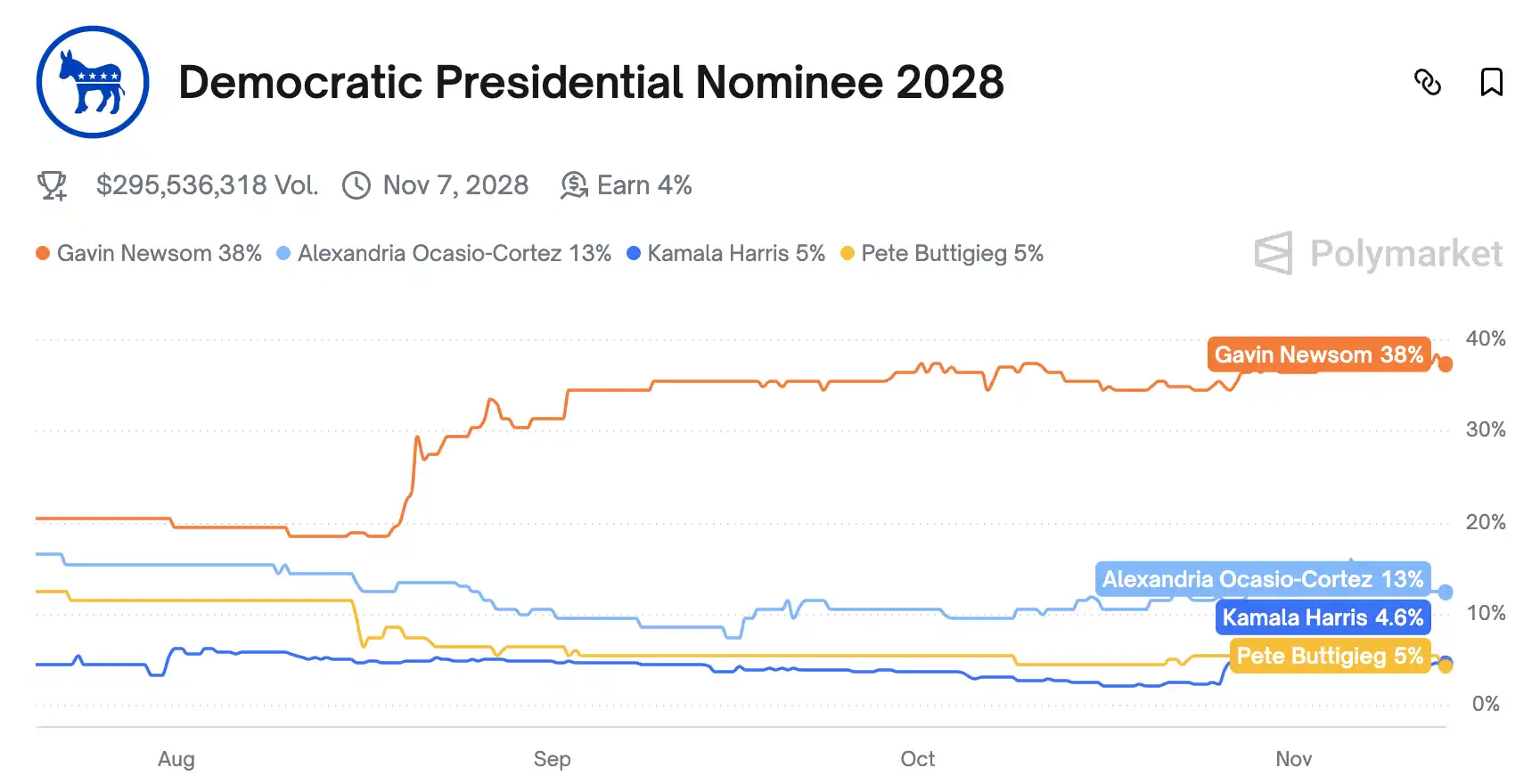
Newsom has consistently held the first place for the 2028 Democratic presidential nominee on Polymarket.
4. New York City Mayor Election: 34-year-old Democratic candidate Zohran Mamdani easily won, receiving over 1.03 million votes, with a voting rate of 52-55%. He became the first mayor in New York's history from the post-90s generation, the first Muslim mayor, and the first mayor of Indian descent.
Even more crucial is the symbolic significance of New York. Among the votes supporting Mamdani, many come from young people who once supported Trump, and he has also been nicknamed "the left-wing Trump." In other words, this largest city in America, Trump's old hometown, has seen nearly 90% of young people switch sides to the Democratic Party.
U.S. governor and mayor elections are staggered to avoid the "down-ballot effect" of federal elections, allowing local voters to focus more on local issues. Governors mostly have 4-year terms, but election years vary by state; mayors serve 2-4 years, with more flexible election timings. However, precisely because of this staggered approach, these local elections have become important barometers of federal elections, often foreshadowing national political trends. These governors and mayors are also important sources of future federal candidates.
For the 2026 midterm elections, the recent comprehensive victory of the Democratic Party in state elections has provided strong momentum, with many foreign media and analysts believing it is a precursor to a "blue wave" similar to 2017. This serves as a political warning to Trump. If he does not do something soon, he may replay the scenario of losing the House control in the first term due to local election failures in 2017.
In American politics, the first year in office is often a honeymoon period, the second year is the dislike period, and the next two years are usually lame-duck years. But Trump probably didn't expect his honeymoon period to be so short and his defeat to come so quickly.
Even though he still controls both chambers, Trump cannot have it all his way all the time. The recent U.S. government shutdown is a prime example of this.
The core contradiction of this recent U.S. government shutdown can be summed up as follows: The Senate requires 60 votes to move forward with reopening the government, and this is an iron rule. The Republican Party wanted a vote from the Democratic Party, and the Democrats' condition was to extend a soon-to-expire health insurance subsidy, but Trump disagreed.
Under the leadership of minority party leader Chuck Schumer, the Democratic Party refused to vote 14 times, standing united like a family.
In contrast, the Republican Party was full of infighting and discord. Trump repeatedly demanded breaking the rules to eliminate the 60-vote threshold, but was rejected by Senate Republican leaders, as they feared that abolishing the obstructive rules would backfire when the Democratic Party regained power. It is said that Trump was very angry and cursed these Republican leaders.
Ultimately, the Republican Party compromised, and Trump was forced to accept a package deal that included Democratic Party priorities in order to reopen the U.S. government. This also clearly demonstrates that the united Democratic Party has the ability to obstruct the Republican Party's agenda, and Trump's control over the two chambers is being weakened.
This shutdown created the longest record in U.S. history, with a large number of government employees on unpaid leave and many low-income individuals unable to receive subsidies, resulting in significant economic losses that severely damaged the Republican Party's image.
Americans' dissatisfaction has reached a critical point. Livelihoods will always be the top political priority.
Dissatisfaction with living standards is actually decreasing, dissatisfaction with cracking down on illegal immigration is causing widespread unease, and various divisions are making people very anxious. Millions of people from the upper-middle class have realized that they are experiencing social downward mobility and are feeling panicked about it.
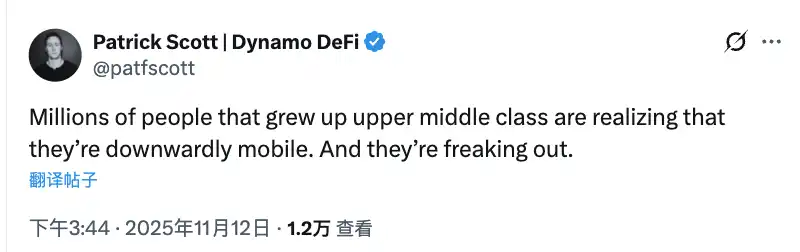
Millions of people from the upper-middle class have realized that they are experiencing social downward mobility and are feeling panicked about it
Food inflation is also key. What used to cost $100 now costs $250, with even lower quality. Just as the egg price surge has eased, America's favorite beef is facing a new wave of inflation.
The latest Consumer Price Index (CPI) released on October 24 showed that the prices of roast beef and steak rose by 18.4% and 16.6% year-on-year, respectively. According to data from the U.S. Department of Agriculture, the retail price of ground beef has soared to $6.1 per pound, reaching a historic high. Compared to three years ago, beef prices have cumulatively risen by over 50%.
In addition, coffee prices rose by 18.9%, natural gas prices rose by 11.7%, electricity costs rose by 5.1%, and car maintenance fees rose by 11.5%. Many American young people who are already burdened with debt from university education are facing even greater pressure due to further cost of living increases.
The 2026 U.S. midterm elections are scheduled for November 3. Following the Democratic Party's significant victory in the 2025 gubernatorial elections, they have gained strong momentum to reclaim control of the House of Representatives. If the Democratic Party were to control both chambers of Congress in next year's midterm elections, Trump's next two years would undoubtedly be full of constraints, rendering him completely ineffective.
For the crypto market, increased regulation may be on the horizon. This means that those who have bet on Trump-friendly policies will need to reconsider their direction, and the downward trend may not even wait until the midterm elections.
A December Rate Cut Is Not Set in Stone
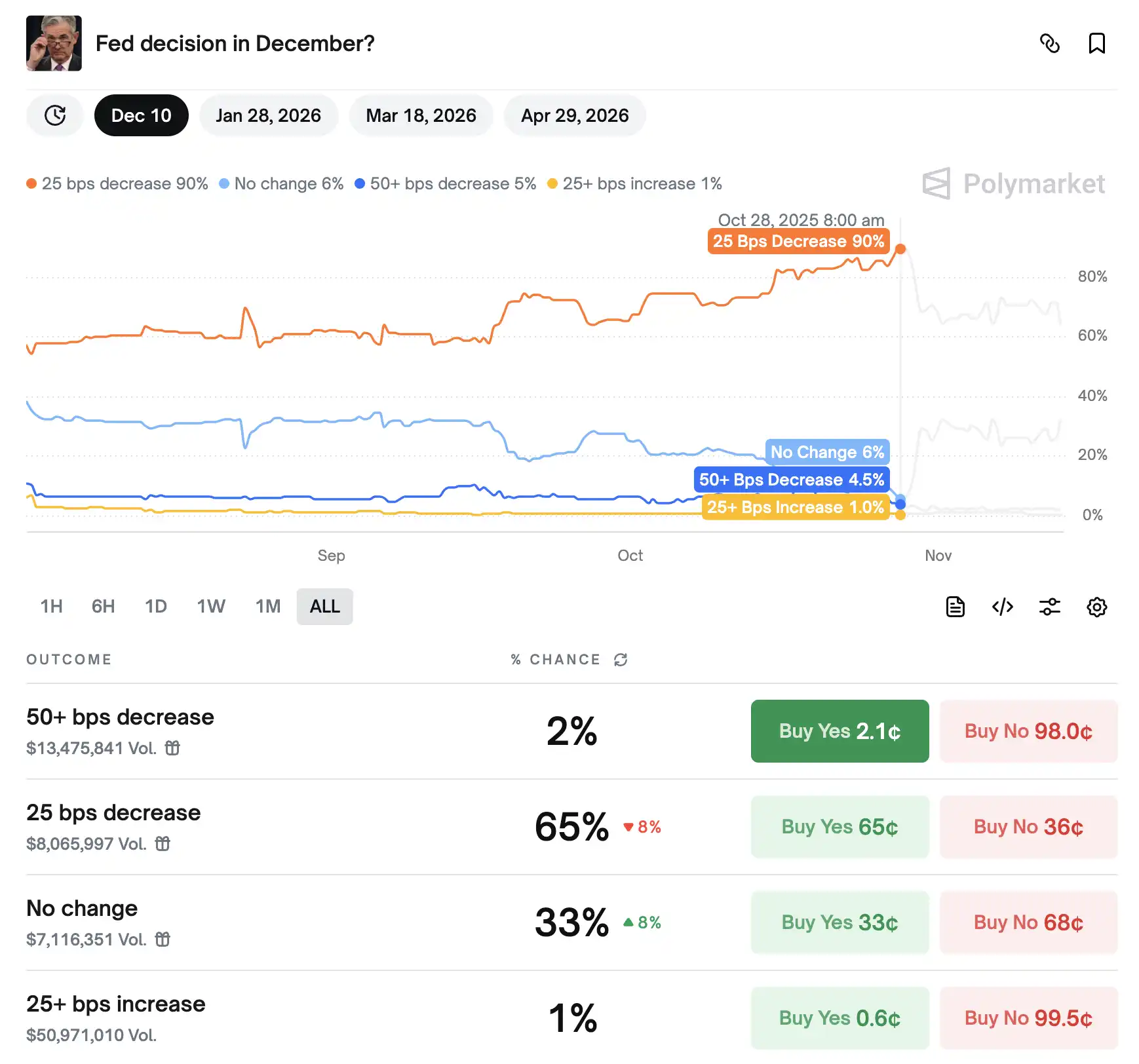
The previously 90% probable rate cut at the December 10 Federal Reserve meeting has now decreased to 65% on Polymarket.
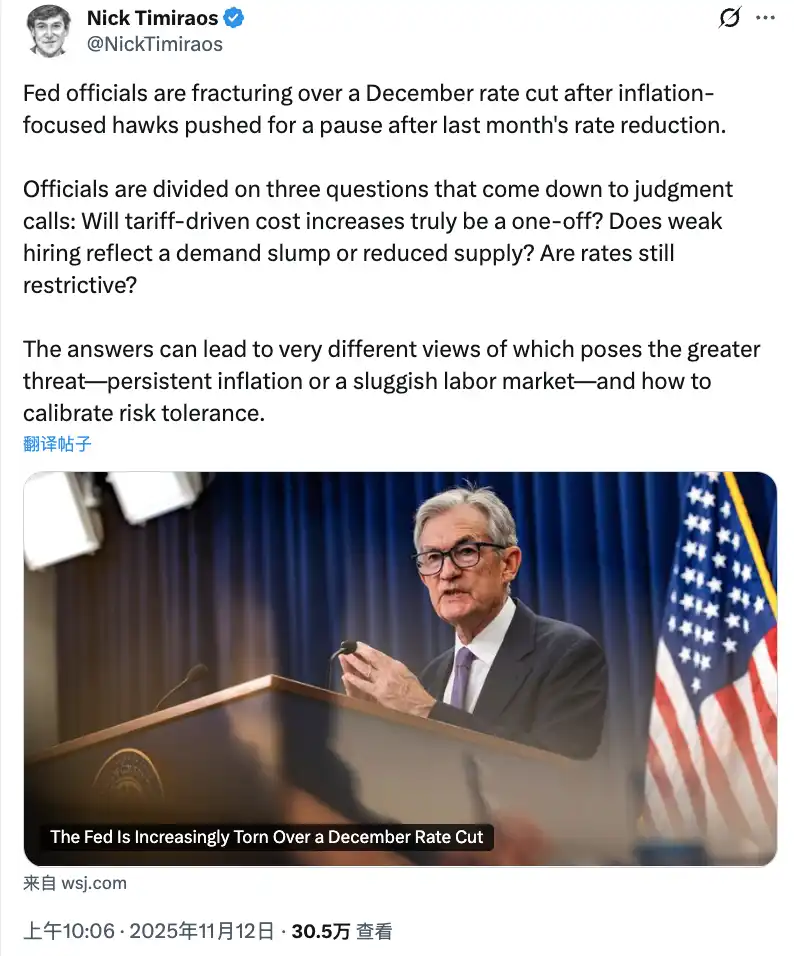
The "Fed Whisperer" Nick Timiraos stated that four voting regional Fed presidents (Boston Fed's Collins, St. Louis Fed's Muzinich, Chicago Fed's Gürkaynak, and Kansas City Fed's Schmidt, who voted against the rate cut decision in October) have not been actively pushing for another rate cut in December. Related Reading: "Fed Whisperer Analysis: Why Has the Fed's Rate Cut Path Suddenly Hit a Roadblock?"
Fed officials are increasingly divided over a December rate cut. Hawks who were previously focused on inflation issues are now advocating for a pause after last month's rate cut. Officials are divided on three key issues:
First, is the cost increase due to tariffs truly one-off? Hawks are concerned that after absorbing the initial tariff costs, companies will pass on more costs to consumers next year, further driving up prices. Doves, however, believe that companies have so far been reluctant to pass on additional tariff costs to consumers, indicating weak demand that is insufficient to support inflation.
Second, is the slowdown in monthly nonfarm payroll growth due to weak labor demand or a lack of labor supply due to reduced immigration? If it's the former, maintaining high rates will lead to an economic downturn; if it's the latter, a rate cut may overstimulate demand.
Third, are rates still restrictive to the economy? Hawks argue that after a 0.5 percentage point rate cut this year, rates are at or near a neutral level that neither stimulates nor inhibits economic growth, making further rate cuts riskier. Doves believe that rates are still restrictive and, without reigniting inflation, a rate cut can support labor market recovery.
In August, Powell attempted to ease the debate during his speech in Jackson Hole, Wyoming, stating that the impact of tariffs was only temporary. He believed that the weakness in the labor market reflected soft demand, thus taking a dovish stance and supporting a rate cut. Data released a few weeks later confirmed his view: the economic slowdown had actually halted job creation.
However, at the meeting on October 29, the hawkish voices rose again.
Kansas City Fed President Jeff Schmid dissented from a rate cut that month. Several non-voting Fed bank presidents, such as Cleveland Fed President Beth Hammack and Dallas Fed President Lorie Logan, also openly opposed a rate cut.
During the post-meeting press conference, Powell bluntly stated that a rate cut in December was not a done deal. Therefore, it is currently difficult to predict whether the Fed will cut rates again at the meeting on December 9-10.
More importantly, Fed Chair Powell's term is also coming to an end. His chairmanship is set to conclude on May 15, 2026. Most analysts believe Powell will not risk appearing panicky and that maintaining the status quo is the safest choice.
The dual uncertainty of politics and monetary policy is also putting the crypto market to the test.
Renowned analyst Willy Woo has put forward a profound viewpoint: the two main forces that have historically driven Bitcoin's price up are gradually fading away, and what will truly determine the market in the future is not the halving or liquidity, but the macroeconomy itself.
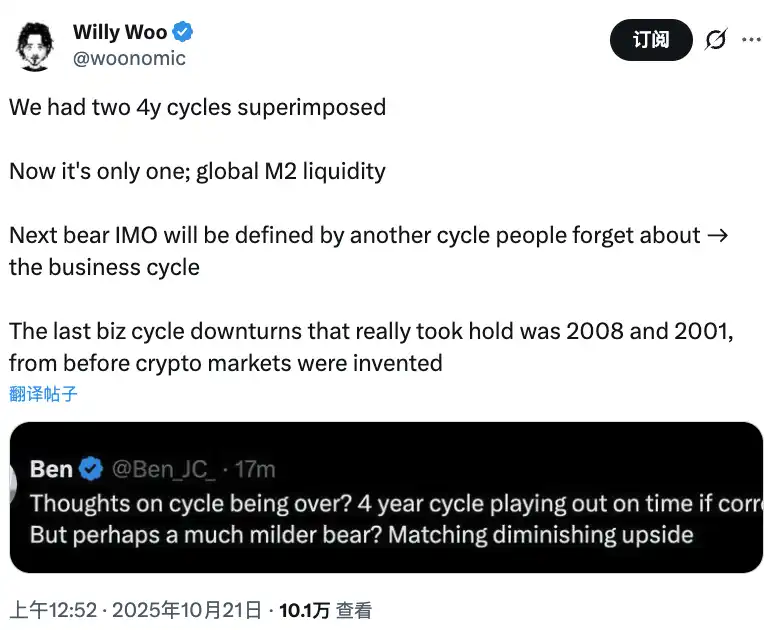
For over a decade, Bitcoin's history has been almost entirely built on the "overlaying effect of two four-year cycles": the halving cycle of Bitcoin itself and the global liquidity (M2) cycle. Whenever the narrative of supply contraction from the halving met the liquidity expansion driven by central banks, a strong resonance was formed—this was the underlying driver of the past two bull markets. However, now, as the cycles are out of sync, this resonance has disappeared, leaving only liquidity to act alone.
"The past two real economic recessions, the bursting of the dot-com bubble in 2001 and the financial crisis in 2008, both occurred before Bitcoin's birth. In other words, we have never seen how Bitcoin would perform in a complete economic recession."
Therefore, Willy Woo implies that the bull market era, which was previously driven by a double-cycle resonance, has ended. Bitcoin has lost its past "natural accelerator," and the driving force behind its growth may be weaker, more reliant on external factors. The current trend of Bitcoin may have already indicated to us in advance that the "top is in."
Furthermore, Galaxy Digital has recently lowered its Bitcoin price target. They have reduced their year-end target from $185,000 to $120,000, citing reasons such as large-scale selling by whales, fund rotation into gold and AI assets, and leveraged liquidations. Galaxy's research head, Alex Thorn, described this period as a "mature era" characterized by lower volatility and institutional dominance in the market.
What Do the Bulls Say?
Of course, not everyone is pessimistic.
US Government Opening the Floodgates
Real Vision CEO Raoul Pal is optimistic that the crypto market will quickly recover from the ongoing turmoil.
"The road to Valhalla is very close now," Pal said. In essence, Pal believes the crypto industry will soon enter an upward trend after a series of market collapses.
Pal's logic is as follows: The US government shutdown has indeed caused a liquidity crunch. Taxes are still coming in, but spending is at zero. The Treasury General Account (TGA) balance is approaching $1 trillion, which is the main reason for the liquidity tightening and Bitcoin underperforming compared to bonds.
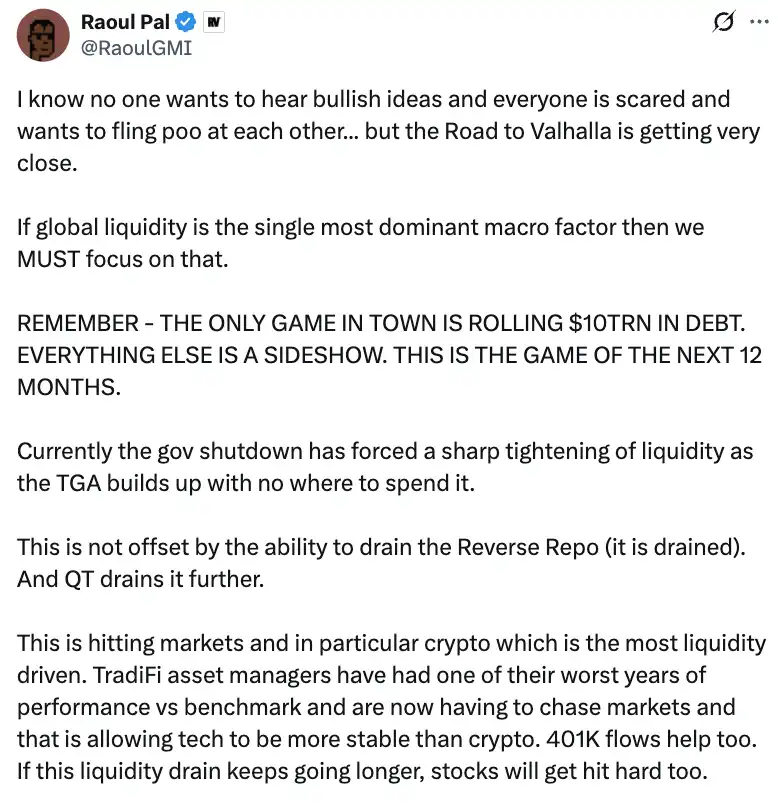
However, this is precisely the signal of a turning point. Related reading: "US Government Set to Reopen, Bitcoin Finally Set to Rise."
In response, the Federal Reserve has been forced to restart temporary repurchase operations (Overnight Repo), planning to inject nearly $30 billion into the market.
More crucially, in the next phase, once the government shutdown ends, the Treasury will begin spending $250 to $350 billion in the coming months.
When this happens, quantitative tightening will end, and the balance sheet will technically expand. This means that the crypto track will gain free liquidity.
Historical trends also support this assessment. When the Treasury Department replenishes reserves and liquidity becomes extremely tight, it often signals an upcoming reversal. In other words, the current pain is the darkness before the dawn.
Raoul Pal also put forward an important point: "The four-year cycle is now a five-year cycle... Bitcoin should peak in 2026. Possibly in the second quarter."
This assessment directly addresses the concerns of the bearish camp regarding "cycle resonance disappearance."
Pal's view is that the cycle has not disappeared but has lengthened. If the peak is in the second quarter of 2026, then the current position is actually a good entry point.
Moreover, even if liquidity alone is at play, it is enough to drive Bitcoin's rise — provided liquidity is indeed expanding. And the massive post-government-shutdown spending is the beginning of liquidity expansion.
BitMEX co-founder Arthur Hayes also echoed similar sentiments. He linked Bitcoin's decline to an 8% drop in USD liquidity since July, believing that once the Treasury balance decreases after the shutdown, USD liquidity will rebound, driving BTC higher.
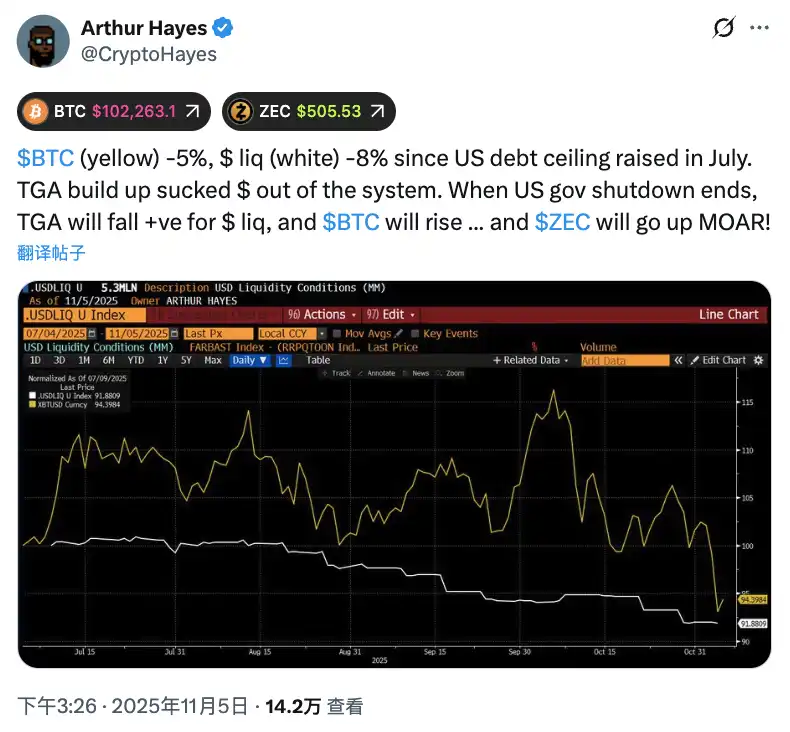
In his latest content on Substack's "Hallelujah," Hayes provided a deeper analysis: The U.S. will have to issue about $2 trillion in new debt each year for the next few years, in addition to rolling over old debt. With decreasing purchasing power from the private sector and foreign central banks, the RV fund will increasingly rely on SRF financing. This will force the Fed to continue expanding its balance sheet, resulting in the effect of "stealth QE." Ultimately, the supply of the dollar will continue to expand, which is fuel for the rise in Bitcoin's price.
Therefore, Arthur believes that the current weakness in the crypto market is just liquidity temporarily locked up by the Treasury — during the government shutdown, the Treasury absorbed USD liquidity through debt issuance but has not yet released spending. When the government reopens, these funds will flow back into the market, once again easing liquidity. Meanwhile, the market may mistakenly think this is the peak, leading to Bitcoin sell-offs, but that will be a "major misjudgment." The real bull market will reignite from the moment the "stealth QE" begins.
And JPMorgan analysts also remain bullish on Bitcoin, expecting the price to rise to $170,000 in the next 6 to 12 months as leverage in the futures market resets, based on technical repairs.
The recent weeks' downturn was largely driven by leverage liquidations. Once the leverage reset is complete and the drag of excessive leverage is removed, Bitcoin is actually poised for an easier path to upside.
The Fast-Tracked CLARITY Act
The second key reason for the bullish camp is the improving regulatory environment, with the centerpiece being the CLARITY Act.
Real Vision CEO Raoul Pal has emphasized time and again that establishing favorable crypto regulation will provide a strong backbone for the market. His logic is simple: once the CLARITY Act is passed, banks and brokers will get the regulatory green light to mass custody and trade physically-backed crypto ETFs.
The CLARITY Act passed the House on July 17 and crucially had bipartisan support—78 Democratic representatives voted in favor, a key number signaling that this is not a one-party wish but a bipartisan grounding.
Then, on November 10, the Senate Agriculture Committee released a bipartisan discussion draft. The timing here is delicate—it is the first major legislative advancement post government shutdown cease.
The release came from the Senate Committee on Agriculture, Nutrition, and Forestry, led by chairman John Boozman (R-Ark.) and ranking member Cory Booker (D-N.J.). Again, a bipartisan effort.
Market watchers anticipate the bill to pass by the end of Q4 2025. The White House is more ambitious: legislate it all by the end of 2025.
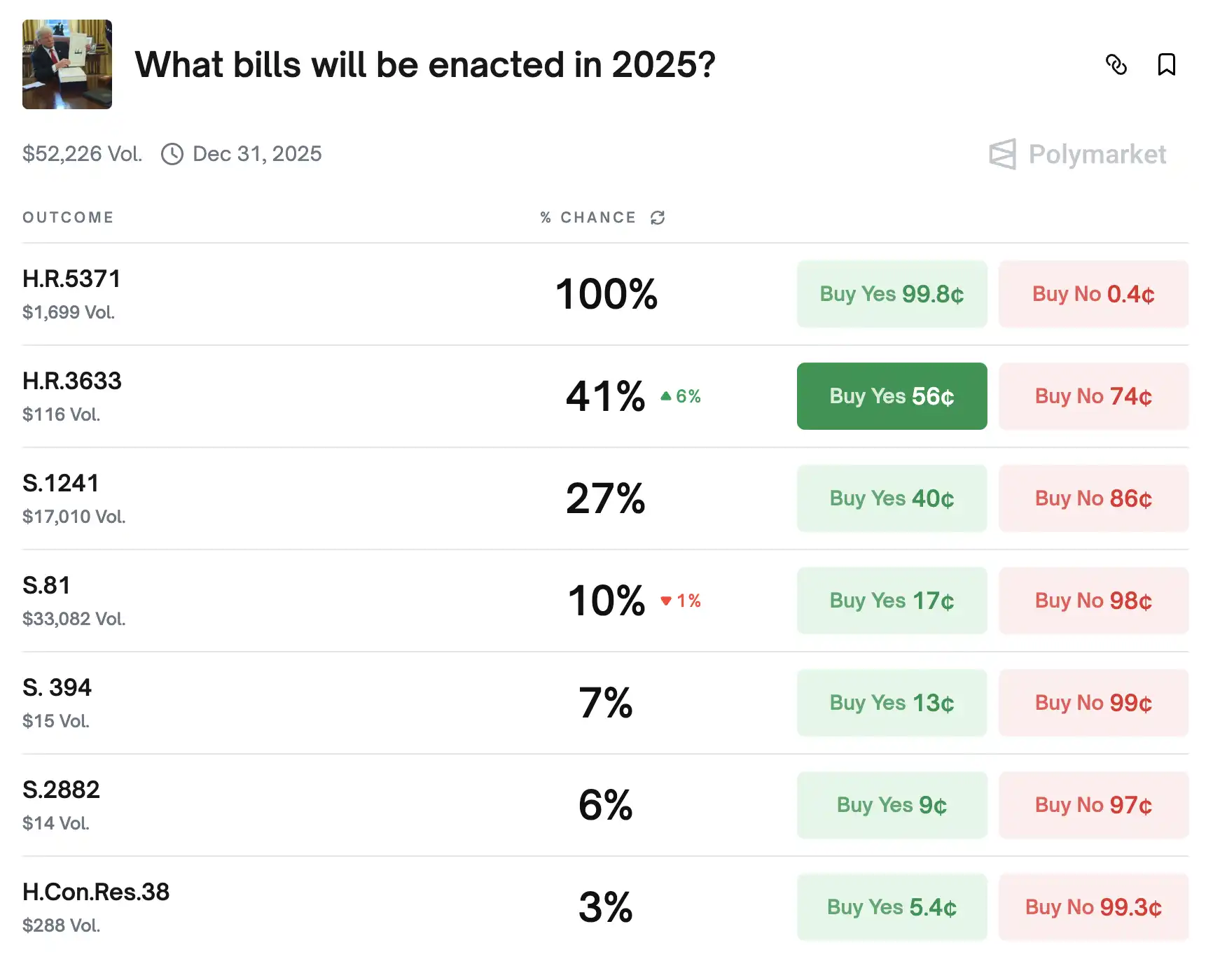
Currently, the probability of the CLARITY Act (H.R.3633) passing in the "Which Bills Will Be Enacted by 2025?" market on Polymarket is 41%.
From July to November, it only took 4 months to progress from the House to the Senate discussion phase. Such speed is not common in U.S. legislative history.
What does this bill really change? At its core: shifting primary regulatory authority for the spot digital commodity market to the CFTC, significantly reducing the SEC's purview.
Specifically: the CFTC gains exclusive jurisdiction over the spot digital commodity market, including mainstream assets like Bitcoin, Ethereum, and more. This means the CFTC can regulate digital commodity exchanges, brokers, traders, and custodians, establish anti-manipulation standards, system safeguards, and risk management requirements. In turn, the SEC loses the exclusive oversight of security-type digital assets. The former state of regulatory uncertainty through enforcement will come to a complete end.
The bill's treatment of stablecoins is even more ingenious. It creates a special status for "Licensed Payment Stablecoins": the CFTC's regulatory scope will only cover the regulation of stablecoin transactions, solicitation, and acceptance on registered platforms. The regulator will not have authority over the operations, reserves, or issuance process of stablecoin issuers. This complements the GENIUS Act (focused on issuer licensing and reserves), avoiding regulatory conflicts.
This design is very clever. It separates the regulatory oversight of stablecoin transactional activities from issuance activities, avoiding the awkward situation where an asset is simultaneously monitored by two regulatory entities. The market structure impact is direct; platforms must register with the CFTC to engage in stablecoin spot transactions, but issuers retain autonomy to avoid overregulation.
This is a significant positive development for major stablecoins such as Ripple's RLUSD stablecoin, Circle's USDC, Tether's USDT, and others.
Powell's Countdown
Fed Chair Powell, who did not heed Trump, is now in the countdown to the end of his term, which expires on May 15, 2026, with six months remaining.
In the coming months, the selection of the next Federal Reserve Chair will be a focus of market attention. The government has narrowed down the list of candidates but has not yet announced a specific nominee.
Currently, the candidate with the highest probability on Polymarket is Hassett (Kevin Hassett), who is the former Chair of the White House Council of Economic Advisers and has deep ties to President Trump. Due to his position, he analyzed economic data for Trump almost daily and was even called Trump's "economic professor" by the President. Their policy philosophies align, with Hassett being a dove through and through, advocating for rate cuts to stimulate economic growth.
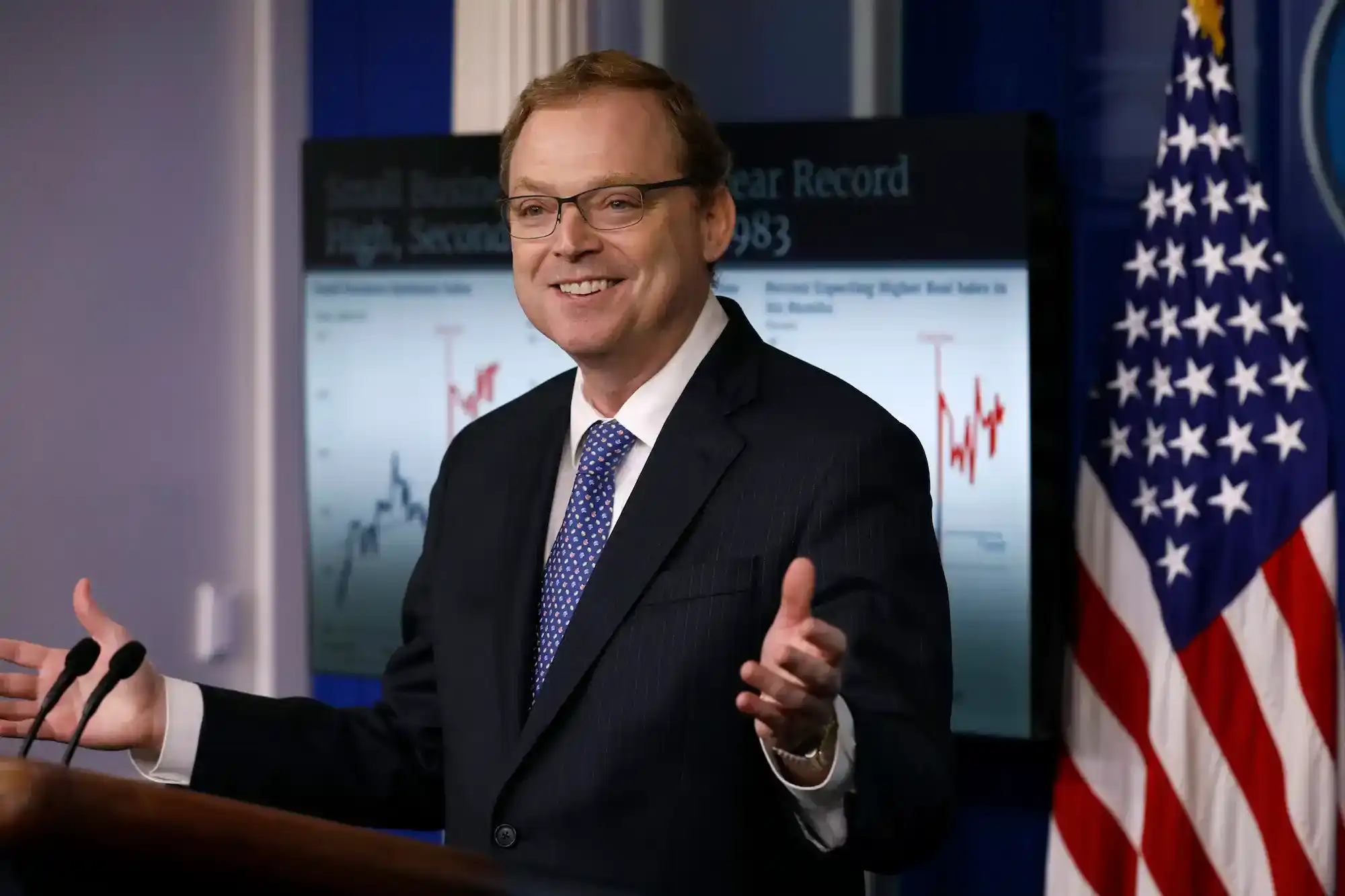
During Trump's first term, Hassett publicly criticized Powell's rate hike policies multiple times, believing that the Fed was tightening monetary policy too aggressively, which would harm economic recovery.
This year, the Fed has faced unprecedented political pressure from the Trump administration for not cutting rates more aggressively. This political pressure is changing the internal power dynamics of the Fed, as evidenced by a recent example.
On November 13, as reported by the "Fed Whisperer" Nick Timiraos, Atlanta Fed President Raphael Bostic suddenly announced that he would retire when his current five-year term ends at the end of February next year. This announcement was delicate given the timing of a potential rate cut in December.
After all, Bostic is one of the most hawkish generals within the Fed, and his departure will weaken the hawkish voice within the Fed during a politically sensitive period.
Futures market pricing indicates that by the end of 2026, the Fed will cut rates at least 4 times, by 25 basis points each time. If Hassett does become the Fed chair, coupled with the gradual decline of the hawkish voice within the Fed, undoubtedly, the speed and magnitude of rate cuts will exceed market expectations. Liquidity will be significantly released, and risk assets will experience a strong upward surge.
For the cryptocurrency market, this is a very significant positive development.
Another politically critical event is Trump's efforts to mend fences with former allies. The signal came on November 4th when Trump announced the re-nomination of Musk's friend, Isaacman, as the director of NASA.

Following the announcement, Isaacman's friend and SpaceX CEO, Elon Musk, promptly retweeted this news.
In December last year, Trump first nominated Isaacman as the NASA director, but withdrew the nomination in May of this year after a fierce argument with Musk over the "Beautiful Law Act," appointing Transportation Secretary Sean Duffy as the acting NASA director, a move aimed at reining in Musk. Subsequently, the two engaged in a heated exchange, staging a "breakup of the century."
Starting in August this year, a turning point emerged. According to The Wall Street Journal, while considering launching the "American Party," Musk's focus has been on maintaining his relationship with Vice President Vance. Sources said that Musk has been in touch with Vance in recent weeks. He admitted to his assistants that if he continues to advance the plan to form a political party, it will damage his relationship with Vance. Reports say that Musk and his aides have informed close associates that if Vance decides to run in the 2028 presidential election, Musk will consider leveraging his vast financial resources to support him, which is indeed the optimal solution for Musk after returning to rational thinking.
In September, the media captured Trump and Musk appearing together at Charlie Kirk's memorial service and shaking hands, indicating a thaw in their relationship. In fact, several U.S. media outlets have reported that with Musk's warming ties to the Republican Party, Isaacman seems to have gradually re-entered the discussion for the nomination of NASA director.

Trump and Musk Engage in Heart-to-Heart Conversation at Kirk's Memorial Service
The November 4th renomination is another signal of reconciliation, and the timing is quite delicate, coming right after the Democratic Party's local election victory.
The bearish camp sees Trump's declining approval rating, Republican compromises, and a dim outlook for 2026. The bullish camp sees the Republican Party consolidating its power, repairing ally relationships, preparing to push through key legislation by the end of the year, and continuing to impact the 2026 midterm elections.
Uncertainty Itself Is the Greatest Certainty
How high will Bitcoin rise? Traders and analysts have given different answers ranging from $120,000 to $170,000.
After reviewing all the arguments from both the bear and bull sides, three viewpoints can be summarized.
First, short-term focuses on liquidity, mid-term focuses on regulation, and long-term focuses on the cycle.
If only looking at the next few weeks, the just-ended government shutdown + ongoing liquidity tightness + escalating political uncertainty indeed create pressure. Galaxy's year-end target of $120,000 may be a relatively conservative but realistic expectation.
However, looking ahead to six to twelve months, a combination of large-scale government spending + the enactment of the "CLARITY Act" + liquidity release may drive the price closer to $170,000. JPMorgan Chase's assessment has its rationale.
As for Raoul Pal's prediction of reaching a peak in the second quarter of 2026, that is more of a long-term cycle judgment. Assuming a five-year cycle instead of a four-year cycle, if this assumption holds true, now may be a good time to position oneself.
The key is to clearly identify the trading timeframe. Short-term traders should focus on liquidity data and government spending progress, mid-term holders should keep an eye on the "CLARITY Act" and the Fed's turnover, while long-term investors should contemplate the business cycle and Bitcoin's fundamental positioning.
Second, political risks have been overestimated but cannot be entirely ignored.
The Democratic Party's victory in local elections does pose a threat to the 2026 midterm elections. However, from now until the midterm elections, there is a full year left.
A lot can happen politically in a year. Trump's reconciliation with Musk, the possibility of the Republican Party pushing through more favorable laws by the year's end, and improved economic data could also reverse public opinion.
More importantly, even if the Democratic Party regains control of Congress in 2026, the key crypto regulatory framework, if established in 2025, is unlikely to be overturned in the short term. The CLARITY Act received support from 78 Democratic lawmakers in the House, indicating bipartisan backing.
A characteristic of U.S. politics is "a big ship is hard to turn around." Once a regulatory framework is set, even with party changes, it is challenging to fully reverse in the short term.
Therefore, the logic chain of betting on "Democratic Party victory leading to crypto doomsday" is oversimplified. Political risks exist, but they are not as fatal as the market imagines.
What is truly worth vigilant about is political uncertainty itself. When the market is in the dark about who will win in the long term, funds tend to stay on the sidelines. This kind of wait-and-see sentiment may harm the market more than any one side winning.
Thirdly, the biggest risk is not political but economic recession.
The "business cycle" concerns raised by the bears are actually the most significant risks to consider.
If the U.S. economy indeed enters a recession, will Bitcoin plummet like tech stocks or become a safe haven asset like gold?
This question has no historical answer because Bitcoin has never experienced a full economic recession cycle. The 2001 Internet bubble and the 2008 financial crisis both occurred before Bitcoin's inception.
From the current data, signs of economic slowdown do exist: sluggish job growth, declining consumer spending, cautious business investment, and food inflation pressuring the middle class.
If these trends persist, 2026 may truly face the risk of a recession. At that time, liquidity releases, regulatory friendliness, Trump-Musk reconciliation, all these could become ineffective. Bitcoin will face a real stress test.
This is also why although JPMorgan has a $170,000 target, they also emphasize the need for a "leverage reset"; why Raoul Pal is bullish for 2026 but also acknowledges that "the market will fluctuate erratically until the stealth QE begins." They are all waiting for a confirmation signal: Can the economy achieve a soft landing?
When will the government reopen? When will the CLARITY Act pass? Will the Fed cut rates in December? How will the results of the 2026 midterm elections be? The answers to these questions will determine Bitcoin's short-term trajectory.
But the longer-term question is: how will Bitcoin perform in the next economic recession? This answer may not be revealed until 2026. Until then, traders will continue to debate, and the market will remain volatile. The only certainty is this: uncertainty itself is still the greatest certainty.
You may also like

From 0 to $1 Million: Five Steps to Outperform the Market Through Wallet Tracking

Token Cannot Compound, Where Is the Real Investment Opportunity?

February 6th Market Key Intelligence, How Much Did You Miss?

China's Central Bank and Eight Other Departments' Latest Regulatory Focus: Key Attention to RWA Tokenized Asset Risk
Foreword: Today, the People's Bank of China's website published the "Notice of the People's Bank of China, National Development and Reform Commission, Ministry of Industry and Information Technology, Ministry of Public Security, State Administration for Market Regulation, China Banking and Insurance Regulatory Commission, China Securities Regulatory Commission, State Administration of Foreign Exchange on Further Preventing and Dealing with Risks Related to Virtual Currency and Others (Yinfa [2026] No. 42)", the latest regulatory requirements from the eight departments including the central bank, which are basically consistent with the regulatory requirements of recent years. The main focus of the regulation is on speculative activities such as virtual currency trading, exchanges, ICOs, overseas platform services, and this time, regulatory oversight of RWA has been added, explicitly prohibiting RWA tokenization, stablecoins (especially those pegged to the RMB). The following is the full text:
To the people's governments of all provinces, autonomous regions, and municipalities directly under the Central Government, the Xinjiang Production and Construction Corps:
Recently, there have been speculative activities related to virtual currency and Real-World Assets (RWA) tokenization, disrupting the economic and financial order and jeopardizing the property security of the people. In order to further prevent and address the risks related to virtual currency and Real-World Assets tokenization, effectively safeguard national security and social stability, in accordance with the "Law of the People's Republic of China on the People's Bank of China," "Law of the People's Republic of China on Commercial Banks," "Securities Law of the People's Republic of China," "Law of the People's Republic of China on Securities Investment Funds," "Law of the People's Republic of China on Futures and Derivatives," "Cybersecurity Law of the People's Republic of China," "Regulations of the People's Republic of China on the Administration of Renminbi," "Regulations on Prevention and Disposal of Illegal Fundraising," "Regulations of the People's Republic of China on Foreign Exchange Administration," "Telecommunications Regulations of the People's Republic of China," and other provisions, after reaching consensus with the Cyberspace Administration of China, the Supreme People's Court, and the Supreme People's Procuratorate, and with the approval of the State Council, the relevant matters are notified as follows:
(I) Virtual currency does not possess the legal status equivalent to fiat currency. Virtual currencies such as Bitcoin, Ether, Tether, etc., have the main characteristics of being issued by non-monetary authorities, using encryption technology and distributed ledger or similar technology, existing in digital form, etc. They do not have legal tender status, should not and cannot be circulated and used as currency in the market.
The business activities related to virtual currency are classified as illegal financial activities. The exchange of fiat currency and virtual currency within the territory, exchange of virtual currencies, acting as a central counterparty in buying and selling virtual currencies, providing information intermediary and pricing services for virtual currency transactions, token issuance financing, and trading of virtual currency-related financial products, etc., fall under illegal financial activities, such as suspected illegal issuance of token vouchers, unauthorized public issuance of securities, illegal operation of securities and futures business, illegal fundraising, etc., are strictly prohibited across the board and resolutely banned in accordance with the law. Overseas entities and individuals are not allowed to provide virtual currency-related services to domestic entities in any form.
A stablecoin pegged to a fiat currency indirectly fulfills some functions of the fiat currency in circulation. Without the consent of relevant authorities in accordance with the law and regulations, any domestic or foreign entity or individual is not allowed to issue a RMB-pegged stablecoin overseas.
(II)Tokenization of Real-World Assets refers to the use of encryption technology and distributed ledger or similar technologies to transform ownership rights, income rights, etc., of assets into tokens (tokens) or other interests or bond certificates with token (token) characteristics, and carry out issuance and trading activities.
Engaging in the tokenization of real-world assets domestically, as well as providing related intermediary, information technology services, etc., which are suspected of illegal issuance of token vouchers, unauthorized public offering of securities, illegal operation of securities and futures business, illegal fundraising, and other illegal financial activities, shall be prohibited; except for relevant business activities carried out with the approval of the competent authorities in accordance with the law and regulations and relying on specific financial infrastructures. Overseas entities and individuals are not allowed to illegally provide services related to the tokenization of real-world assets to domestic entities in any form.
(III) Inter-agency Coordination. The People's Bank of China, together with the National Development and Reform Commission, the Ministry of Industry and Information Technology, the Ministry of Public Security, the State Administration for Market Regulation, the China Banking and Insurance Regulatory Commission, the China Securities Regulatory Commission, the State Administration of Foreign Exchange, and other departments, will improve the work mechanism, strengthen coordination with the Cyberspace Administration of China, the Supreme People's Court, and the Supreme People's Procuratorate, coordinate efforts, and overall guide regions to carry out risk prevention and disposal of virtual currency-related illegal financial activities.
The China Securities Regulatory Commission, together with the National Development and Reform Commission, the Ministry of Industry and Information Technology, the Ministry of Public Security, the People's Bank of China, the State Administration for Market Regulation, the China Banking and Insurance Regulatory Commission, the State Administration of Foreign Exchange, and other departments, will improve the work mechanism, strengthen coordination with the Cyberspace Administration of China, the Supreme People's Court, and the Supreme People's Procuratorate, coordinate efforts, and overall guide regions to carry out risk prevention and disposal of illegal financial activities related to the tokenization of real-world assets.
(IV) Strengthening Local Implementation. The people's governments at the provincial level are overall responsible for the prevention and disposal of risks related to virtual currencies and the tokenization of real-world assets in their respective administrative regions. The specific leading department is the local financial regulatory department, with participation from branches and dispatched institutions of the State Council's financial regulatory department, telecommunications regulators, public security, market supervision, and other departments, in coordination with cyberspace departments, courts, and procuratorates, to improve the normalization of the work mechanism, effectively connect with the relevant work mechanisms of central departments, form a cooperative and coordinated working pattern between central and local governments, effectively prevent and properly handle risks related to virtual currencies and the tokenization of real-world assets, and maintain economic and financial order and social stability.
(5) Enhanced Risk Monitoring. The People's Bank of China, China Securities Regulatory Commission, National Development and Reform Commission, Ministry of Industry and Information Technology, Ministry of Public Security, State Administration of Foreign Exchange, Cyberspace Administration of China, and other departments continue to improve monitoring techniques and system support, enhance cross-departmental data analysis and sharing, establish sound information sharing and cross-validation mechanisms, promptly grasp the risk situation of activities related to virtual currency and real-world asset tokenization. Local governments at all levels give full play to the role of local monitoring and early warning mechanisms. Local financial regulatory authorities, together with branches and agencies of the State Council's financial regulatory authorities, as well as departments of cyberspace and public security, ensure effective connection between online monitoring, offline investigation, and fund tracking, efficiently and accurately identify activities related to virtual currency and real-world asset tokenization, promptly share risk information, improve early warning information dissemination, verification, and rapid response mechanisms.
(6) Strengthened Oversight of Financial Institutions, Intermediaries, and Technology Service Providers. Financial institutions (including non-bank payment institutions) are prohibited from providing account opening, fund transfer, and clearing services for virtual currency-related business activities, issuing and selling financial products related to virtual currency, including virtual currency and related financial products in the scope of collateral, conducting insurance business related to virtual currency, or including virtual currency in the scope of insurance liability. Financial institutions (including non-bank payment institutions) are prohibited from providing custody, clearing, and settlement services for unauthorized real-world asset tokenization-related business and related financial products. Relevant intermediary institutions and information technology service providers are prohibited from providing intermediary, technical, or other services for unauthorized real-world asset tokenization-related businesses and related financial products.
(7) Enhanced Management of Internet Information Content and Access. Internet enterprises are prohibited from providing online business venues, commercial displays, marketing, advertising, or paid traffic diversion services for virtual currency and real-world asset tokenization-related business activities. Upon discovering clues of illegal activities, they should promptly report to relevant departments and provide technical support and assistance for related investigations and inquiries. Based on the clues transferred by the financial regulatory authorities, the cyberspace administration, telecommunications authorities, and public security departments should promptly close and deal with websites, mobile applications (including mini-programs), and public accounts engaged in virtual currency and real-world asset tokenization-related business activities in accordance with the law.
(8) Strengthened Entity Registration and Advertisement Management. Market supervision departments strengthen entity registration and management, and enterprise and individual business registrations must not contain terms such as "virtual currency," "virtual asset," "cryptocurrency," "crypto asset," "stablecoin," "real-world asset tokenization," or "RWA" in their names or business scopes. Market supervision departments, together with financial regulatory authorities, legally enhance the supervision of advertisements related to virtual currency and real-world asset tokenization, promptly investigating and handling relevant illegal advertisements.
(IX) Continued Rectification of Virtual Currency Mining Activities. The National Development and Reform Commission, together with relevant departments, strictly controls virtual currency mining activities, continuously promotes the rectification of virtual currency mining activities. The people's governments of various provinces take overall responsibility for the rectification of "mining" within their respective administrative regions. In accordance with the requirements of the National Development and Reform Commission and other departments in the "Notice on the Rectification of Virtual Currency Mining Activities" (NDRC Energy-saving Building [2021] No. 1283) and the provisions of the "Guidance Catalog for Industrial Structure Adjustment (2024 Edition)," a comprehensive review, investigation, and closure of existing virtual currency mining projects are conducted, new mining projects are strictly prohibited, and mining machine production enterprises are strictly prohibited from providing mining machine sales and other services within the country.
(X) Severe Crackdown on Related Illegal Financial Activities. Upon discovering clues to illegal financial activities related to virtual currency and the tokenization of real-world assets, local financial regulatory authorities, branches of the State Council's financial regulatory authorities, and other relevant departments promptly investigate, determine, and properly handle the issues in accordance with the law, and seriously hold the relevant entities and individuals legally responsible. Those suspected of crimes are transferred to the judicial authorities for processing according to the law.
(XI) Severe Crackdown on Related Illegal and Criminal Activities. The Ministry of Public Security, the People's Bank of China, the State Administration for Market Regulation, the China Banking and Insurance Regulatory Commission, the China Securities Regulatory Commission, as well as judicial and procuratorial organs, in accordance with their respective responsibilities, rigorously crack down on illegal and criminal activities related to virtual currency, the tokenization of real-world assets, such as fraud, money laundering, illegal business operations, pyramid schemes, illegal fundraising, and other illegal and criminal activities carried out under the guise of virtual currency, the tokenization of real-world assets, etc.
(XII) Strengthen Industry Self-discipline. Relevant industry associations should enhance membership management and policy advocacy, based on their own responsibilities, advocate and urge member units to resist illegal financial activities related to virtual currency and the tokenization of real-world assets. Member units that violate regulatory policies and industry self-discipline rules are to be disciplined in accordance with relevant self-regulatory management regulations. By leveraging various industry infrastructure, conduct risk monitoring related to virtual currency, the tokenization of real-world assets, and promptly transfer issue clues to relevant departments.
(XIII) Without the approval of relevant departments in accordance with the law and regulations, domestic entities and foreign entities controlled by them may not issue virtual currency overseas.
(XIV) Domestic entities engaging directly or indirectly in overseas external debt-based tokenization of real-world assets, or conducting asset securitization activities abroad based on domestic ownership rights, income rights, etc. (hereinafter referred to as domestic equity), should be strictly regulated in accordance with the principles of "same business, same risk, same rules." The National Development and Reform Commission, the China Securities Regulatory Commission, the State Administration of Foreign Exchange, and other relevant departments regulate it according to their respective responsibilities. For other forms of overseas real-world asset tokenization activities based on domestic equity by domestic entities, the China Securities Regulatory Commission, together with relevant departments, supervise according to their division of responsibilities. Without the consent and filing of relevant departments, no unit or individual may engage in the above-mentioned business.
(15) Overseas subsidiaries and branches of domestic financial institutions providing Real World Asset Tokenization-related services overseas shall do so legally and prudently. They shall have professional personnel and systems in place to effectively mitigate business risks, strictly implement customer onboarding, suitability management, anti-money laundering requirements, and incorporate them into the domestic financial institutions' compliance and risk management system. Intermediaries and information technology service providers offering Real World Asset Tokenization services abroad based on domestic equity or conducting Real World Asset Tokenization business in the form of overseas debt for domestic entities directly or indirectly venturing abroad must strictly comply with relevant laws and regulations. They should establish and improve relevant compliance and internal control systems in accordance with relevant normative requirements, strengthen business and risk control, and report the business developments to the relevant regulatory authorities for approval or filing.
(16) Strengthen organizational leadership and overall coordination. All departments and regions should attach great importance to the prevention of risks related to virtual currencies and Real World Asset Tokenization, strengthen organizational leadership, clarify work responsibilities, form a long-term effective working mechanism with centralized coordination, local implementation, and shared responsibilities, maintain high pressure, dynamically monitor risks, effectively prevent and mitigate risks in an orderly and efficient manner, legally protect the property security of the people, and make every effort to maintain economic and financial order and social stability.
(17) Widely carry out publicity and education. All departments, regions, and industry associations should make full use of various media and other communication channels to disseminate information through legal and policy interpretation, analysis of typical cases, and education on investment risks, etc. They should promote the illegality and harm of virtual currencies and Real World Asset Tokenization-related businesses and their manifestations, fully alert to potential risks and hidden dangers, and enhance public awareness and identification capabilities for risk prevention.
(18) Engaging in illegal financial activities related to virtual currencies and Real World Asset Tokenization in violation of this notice, as well as providing services for virtual currencies and Real World Asset Tokenization-related businesses, shall be punished in accordance with relevant regulations. If it constitutes a crime, criminal liability shall be pursued according to the law. For domestic entities and individuals who knowingly or should have known that overseas entities illegally provided virtual currency or Real World Asset Tokenization-related services to domestic entities and still assisted them, relevant responsibilities shall be pursued according to the law. If it constitutes a crime, criminal liability shall be pursued according to the law.
(19) If any unit or individual invests in virtual currencies, Real World Asset Tokens, and related financial products against public order and good customs, the relevant civil legal actions shall be invalid, and any resulting losses shall be borne by them. If there are suspicions of disrupting financial order and jeopardizing financial security, the relevant departments shall deal with them according to the law.
This notice shall enter into force upon the date of its issuance. The People's Bank of China and ten other departments' "Notice on Further Preventing and Dealing with the Risks of Virtual Currency Trading Speculation" (Yinfa [2021] No. 237) is hereby repealed.

Former Partner's Perspective on Multicoin: Kyle's Exit, But the Game He Left Behind Just Getting Started
Why Bitcoin Is Falling Now: The Real Reasons Behind BTC's Crash & WEEX's Smart Profit Playbook
Bitcoin's ongoing crash explained: Discover the 5 hidden triggers behind BTC's plunge & how WEEX's Auto Earn and Trade to Earn strategies help traders profit from crypto market volatility.

Wall Street's Hottest Trades See Exodus

Vitalik Discusses Ethereum Scaling Path, Circle Announces Partnership with Polymarket, What's the Overseas Crypto Community Talking About Today?

Believing in the Capital Markets - The Essence and Core Value of Cryptocurrency

Polymarket's 'Weatherman': Predict Temperature, Win Million-Dollar Payout

$15K+ Profits: The 4 AI Trading Secrets WEEX Hackathon Prelim Winners Used to Dominate Volatile Crypto Markets
How WEEX Hackathon's top AI trading strategies made $15K+ in crypto markets: 4 proven rules for ETH/BTC trading, market structure analysis, and risk management in volatile conditions.

A nearly 20% one-day plunge, how long has it been since you last saw a $60,000 Bitcoin?

Raoul Pal: I've seen every single panic, and they are never the end.

Key Market Information Discrepancy on February 6th - A Must-Read! | Alpha Morning Report

2026 Crypto Industry's First Snowfall
The Harsh Reality Behind the $26 Billion Crypto Liquidation: Liquidity Is Killing the Market
Why Is Gold, US Stocks, Bitcoin All Falling?

Key Market Intelligence for February 5th, how much did you miss out on?
From 0 to $1 Million: Five Steps to Outperform the Market Through Wallet Tracking
Token Cannot Compound, Where Is the Real Investment Opportunity?
February 6th Market Key Intelligence, How Much Did You Miss?
China's Central Bank and Eight Other Departments' Latest Regulatory Focus: Key Attention to RWA Tokenized Asset Risk
Foreword: Today, the People's Bank of China's website published the "Notice of the People's Bank of China, National Development and Reform Commission, Ministry of Industry and Information Technology, Ministry of Public Security, State Administration for Market Regulation, China Banking and Insurance Regulatory Commission, China Securities Regulatory Commission, State Administration of Foreign Exchange on Further Preventing and Dealing with Risks Related to Virtual Currency and Others (Yinfa [2026] No. 42)", the latest regulatory requirements from the eight departments including the central bank, which are basically consistent with the regulatory requirements of recent years. The main focus of the regulation is on speculative activities such as virtual currency trading, exchanges, ICOs, overseas platform services, and this time, regulatory oversight of RWA has been added, explicitly prohibiting RWA tokenization, stablecoins (especially those pegged to the RMB). The following is the full text:
To the people's governments of all provinces, autonomous regions, and municipalities directly under the Central Government, the Xinjiang Production and Construction Corps:
Recently, there have been speculative activities related to virtual currency and Real-World Assets (RWA) tokenization, disrupting the economic and financial order and jeopardizing the property security of the people. In order to further prevent and address the risks related to virtual currency and Real-World Assets tokenization, effectively safeguard national security and social stability, in accordance with the "Law of the People's Republic of China on the People's Bank of China," "Law of the People's Republic of China on Commercial Banks," "Securities Law of the People's Republic of China," "Law of the People's Republic of China on Securities Investment Funds," "Law of the People's Republic of China on Futures and Derivatives," "Cybersecurity Law of the People's Republic of China," "Regulations of the People's Republic of China on the Administration of Renminbi," "Regulations on Prevention and Disposal of Illegal Fundraising," "Regulations of the People's Republic of China on Foreign Exchange Administration," "Telecommunications Regulations of the People's Republic of China," and other provisions, after reaching consensus with the Cyberspace Administration of China, the Supreme People's Court, and the Supreme People's Procuratorate, and with the approval of the State Council, the relevant matters are notified as follows:
(I) Virtual currency does not possess the legal status equivalent to fiat currency. Virtual currencies such as Bitcoin, Ether, Tether, etc., have the main characteristics of being issued by non-monetary authorities, using encryption technology and distributed ledger or similar technology, existing in digital form, etc. They do not have legal tender status, should not and cannot be circulated and used as currency in the market.
The business activities related to virtual currency are classified as illegal financial activities. The exchange of fiat currency and virtual currency within the territory, exchange of virtual currencies, acting as a central counterparty in buying and selling virtual currencies, providing information intermediary and pricing services for virtual currency transactions, token issuance financing, and trading of virtual currency-related financial products, etc., fall under illegal financial activities, such as suspected illegal issuance of token vouchers, unauthorized public issuance of securities, illegal operation of securities and futures business, illegal fundraising, etc., are strictly prohibited across the board and resolutely banned in accordance with the law. Overseas entities and individuals are not allowed to provide virtual currency-related services to domestic entities in any form.
A stablecoin pegged to a fiat currency indirectly fulfills some functions of the fiat currency in circulation. Without the consent of relevant authorities in accordance with the law and regulations, any domestic or foreign entity or individual is not allowed to issue a RMB-pegged stablecoin overseas.
(II)Tokenization of Real-World Assets refers to the use of encryption technology and distributed ledger or similar technologies to transform ownership rights, income rights, etc., of assets into tokens (tokens) or other interests or bond certificates with token (token) characteristics, and carry out issuance and trading activities.
Engaging in the tokenization of real-world assets domestically, as well as providing related intermediary, information technology services, etc., which are suspected of illegal issuance of token vouchers, unauthorized public offering of securities, illegal operation of securities and futures business, illegal fundraising, and other illegal financial activities, shall be prohibited; except for relevant business activities carried out with the approval of the competent authorities in accordance with the law and regulations and relying on specific financial infrastructures. Overseas entities and individuals are not allowed to illegally provide services related to the tokenization of real-world assets to domestic entities in any form.
(III) Inter-agency Coordination. The People's Bank of China, together with the National Development and Reform Commission, the Ministry of Industry and Information Technology, the Ministry of Public Security, the State Administration for Market Regulation, the China Banking and Insurance Regulatory Commission, the China Securities Regulatory Commission, the State Administration of Foreign Exchange, and other departments, will improve the work mechanism, strengthen coordination with the Cyberspace Administration of China, the Supreme People's Court, and the Supreme People's Procuratorate, coordinate efforts, and overall guide regions to carry out risk prevention and disposal of virtual currency-related illegal financial activities.
The China Securities Regulatory Commission, together with the National Development and Reform Commission, the Ministry of Industry and Information Technology, the Ministry of Public Security, the People's Bank of China, the State Administration for Market Regulation, the China Banking and Insurance Regulatory Commission, the State Administration of Foreign Exchange, and other departments, will improve the work mechanism, strengthen coordination with the Cyberspace Administration of China, the Supreme People's Court, and the Supreme People's Procuratorate, coordinate efforts, and overall guide regions to carry out risk prevention and disposal of illegal financial activities related to the tokenization of real-world assets.
(IV) Strengthening Local Implementation. The people's governments at the provincial level are overall responsible for the prevention and disposal of risks related to virtual currencies and the tokenization of real-world assets in their respective administrative regions. The specific leading department is the local financial regulatory department, with participation from branches and dispatched institutions of the State Council's financial regulatory department, telecommunications regulators, public security, market supervision, and other departments, in coordination with cyberspace departments, courts, and procuratorates, to improve the normalization of the work mechanism, effectively connect with the relevant work mechanisms of central departments, form a cooperative and coordinated working pattern between central and local governments, effectively prevent and properly handle risks related to virtual currencies and the tokenization of real-world assets, and maintain economic and financial order and social stability.
(5) Enhanced Risk Monitoring. The People's Bank of China, China Securities Regulatory Commission, National Development and Reform Commission, Ministry of Industry and Information Technology, Ministry of Public Security, State Administration of Foreign Exchange, Cyberspace Administration of China, and other departments continue to improve monitoring techniques and system support, enhance cross-departmental data analysis and sharing, establish sound information sharing and cross-validation mechanisms, promptly grasp the risk situation of activities related to virtual currency and real-world asset tokenization. Local governments at all levels give full play to the role of local monitoring and early warning mechanisms. Local financial regulatory authorities, together with branches and agencies of the State Council's financial regulatory authorities, as well as departments of cyberspace and public security, ensure effective connection between online monitoring, offline investigation, and fund tracking, efficiently and accurately identify activities related to virtual currency and real-world asset tokenization, promptly share risk information, improve early warning information dissemination, verification, and rapid response mechanisms.
(6) Strengthened Oversight of Financial Institutions, Intermediaries, and Technology Service Providers. Financial institutions (including non-bank payment institutions) are prohibited from providing account opening, fund transfer, and clearing services for virtual currency-related business activities, issuing and selling financial products related to virtual currency, including virtual currency and related financial products in the scope of collateral, conducting insurance business related to virtual currency, or including virtual currency in the scope of insurance liability. Financial institutions (including non-bank payment institutions) are prohibited from providing custody, clearing, and settlement services for unauthorized real-world asset tokenization-related business and related financial products. Relevant intermediary institutions and information technology service providers are prohibited from providing intermediary, technical, or other services for unauthorized real-world asset tokenization-related businesses and related financial products.
(7) Enhanced Management of Internet Information Content and Access. Internet enterprises are prohibited from providing online business venues, commercial displays, marketing, advertising, or paid traffic diversion services for virtual currency and real-world asset tokenization-related business activities. Upon discovering clues of illegal activities, they should promptly report to relevant departments and provide technical support and assistance for related investigations and inquiries. Based on the clues transferred by the financial regulatory authorities, the cyberspace administration, telecommunications authorities, and public security departments should promptly close and deal with websites, mobile applications (including mini-programs), and public accounts engaged in virtual currency and real-world asset tokenization-related business activities in accordance with the law.
(8) Strengthened Entity Registration and Advertisement Management. Market supervision departments strengthen entity registration and management, and enterprise and individual business registrations must not contain terms such as "virtual currency," "virtual asset," "cryptocurrency," "crypto asset," "stablecoin," "real-world asset tokenization," or "RWA" in their names or business scopes. Market supervision departments, together with financial regulatory authorities, legally enhance the supervision of advertisements related to virtual currency and real-world asset tokenization, promptly investigating and handling relevant illegal advertisements.
(IX) Continued Rectification of Virtual Currency Mining Activities. The National Development and Reform Commission, together with relevant departments, strictly controls virtual currency mining activities, continuously promotes the rectification of virtual currency mining activities. The people's governments of various provinces take overall responsibility for the rectification of "mining" within their respective administrative regions. In accordance with the requirements of the National Development and Reform Commission and other departments in the "Notice on the Rectification of Virtual Currency Mining Activities" (NDRC Energy-saving Building [2021] No. 1283) and the provisions of the "Guidance Catalog for Industrial Structure Adjustment (2024 Edition)," a comprehensive review, investigation, and closure of existing virtual currency mining projects are conducted, new mining projects are strictly prohibited, and mining machine production enterprises are strictly prohibited from providing mining machine sales and other services within the country.
(X) Severe Crackdown on Related Illegal Financial Activities. Upon discovering clues to illegal financial activities related to virtual currency and the tokenization of real-world assets, local financial regulatory authorities, branches of the State Council's financial regulatory authorities, and other relevant departments promptly investigate, determine, and properly handle the issues in accordance with the law, and seriously hold the relevant entities and individuals legally responsible. Those suspected of crimes are transferred to the judicial authorities for processing according to the law.
(XI) Severe Crackdown on Related Illegal and Criminal Activities. The Ministry of Public Security, the People's Bank of China, the State Administration for Market Regulation, the China Banking and Insurance Regulatory Commission, the China Securities Regulatory Commission, as well as judicial and procuratorial organs, in accordance with their respective responsibilities, rigorously crack down on illegal and criminal activities related to virtual currency, the tokenization of real-world assets, such as fraud, money laundering, illegal business operations, pyramid schemes, illegal fundraising, and other illegal and criminal activities carried out under the guise of virtual currency, the tokenization of real-world assets, etc.
(XII) Strengthen Industry Self-discipline. Relevant industry associations should enhance membership management and policy advocacy, based on their own responsibilities, advocate and urge member units to resist illegal financial activities related to virtual currency and the tokenization of real-world assets. Member units that violate regulatory policies and industry self-discipline rules are to be disciplined in accordance with relevant self-regulatory management regulations. By leveraging various industry infrastructure, conduct risk monitoring related to virtual currency, the tokenization of real-world assets, and promptly transfer issue clues to relevant departments.
(XIII) Without the approval of relevant departments in accordance with the law and regulations, domestic entities and foreign entities controlled by them may not issue virtual currency overseas.
(XIV) Domestic entities engaging directly or indirectly in overseas external debt-based tokenization of real-world assets, or conducting asset securitization activities abroad based on domestic ownership rights, income rights, etc. (hereinafter referred to as domestic equity), should be strictly regulated in accordance with the principles of "same business, same risk, same rules." The National Development and Reform Commission, the China Securities Regulatory Commission, the State Administration of Foreign Exchange, and other relevant departments regulate it according to their respective responsibilities. For other forms of overseas real-world asset tokenization activities based on domestic equity by domestic entities, the China Securities Regulatory Commission, together with relevant departments, supervise according to their division of responsibilities. Without the consent and filing of relevant departments, no unit or individual may engage in the above-mentioned business.
(15) Overseas subsidiaries and branches of domestic financial institutions providing Real World Asset Tokenization-related services overseas shall do so legally and prudently. They shall have professional personnel and systems in place to effectively mitigate business risks, strictly implement customer onboarding, suitability management, anti-money laundering requirements, and incorporate them into the domestic financial institutions' compliance and risk management system. Intermediaries and information technology service providers offering Real World Asset Tokenization services abroad based on domestic equity or conducting Real World Asset Tokenization business in the form of overseas debt for domestic entities directly or indirectly venturing abroad must strictly comply with relevant laws and regulations. They should establish and improve relevant compliance and internal control systems in accordance with relevant normative requirements, strengthen business and risk control, and report the business developments to the relevant regulatory authorities for approval or filing.
(16) Strengthen organizational leadership and overall coordination. All departments and regions should attach great importance to the prevention of risks related to virtual currencies and Real World Asset Tokenization, strengthen organizational leadership, clarify work responsibilities, form a long-term effective working mechanism with centralized coordination, local implementation, and shared responsibilities, maintain high pressure, dynamically monitor risks, effectively prevent and mitigate risks in an orderly and efficient manner, legally protect the property security of the people, and make every effort to maintain economic and financial order and social stability.
(17) Widely carry out publicity and education. All departments, regions, and industry associations should make full use of various media and other communication channels to disseminate information through legal and policy interpretation, analysis of typical cases, and education on investment risks, etc. They should promote the illegality and harm of virtual currencies and Real World Asset Tokenization-related businesses and their manifestations, fully alert to potential risks and hidden dangers, and enhance public awareness and identification capabilities for risk prevention.
(18) Engaging in illegal financial activities related to virtual currencies and Real World Asset Tokenization in violation of this notice, as well as providing services for virtual currencies and Real World Asset Tokenization-related businesses, shall be punished in accordance with relevant regulations. If it constitutes a crime, criminal liability shall be pursued according to the law. For domestic entities and individuals who knowingly or should have known that overseas entities illegally provided virtual currency or Real World Asset Tokenization-related services to domestic entities and still assisted them, relevant responsibilities shall be pursued according to the law. If it constitutes a crime, criminal liability shall be pursued according to the law.
(19) If any unit or individual invests in virtual currencies, Real World Asset Tokens, and related financial products against public order and good customs, the relevant civil legal actions shall be invalid, and any resulting losses shall be borne by them. If there are suspicions of disrupting financial order and jeopardizing financial security, the relevant departments shall deal with them according to the law.
This notice shall enter into force upon the date of its issuance. The People's Bank of China and ten other departments' "Notice on Further Preventing and Dealing with the Risks of Virtual Currency Trading Speculation" (Yinfa [2021] No. 237) is hereby repealed.
Former Partner's Perspective on Multicoin: Kyle's Exit, But the Game He Left Behind Just Getting Started
Why Bitcoin Is Falling Now: The Real Reasons Behind BTC's Crash & WEEX's Smart Profit Playbook
Bitcoin's ongoing crash explained: Discover the 5 hidden triggers behind BTC's plunge & how WEEX's Auto Earn and Trade to Earn strategies help traders profit from crypto market volatility.


 App
App