
Decoding Aave V4: A Shift from Product to "Banking"



Original Title: "Decoding Aave V4: A Transformation from Product to 'Bank'"
Original Author: Eric, Foresight News
On the evening of March 30th, Beijing time, the Aave V4 version, which has been in development since 2024, was officially launched on the mainnet, bringing the first piece of good news since the Aave DAO governance dispute.
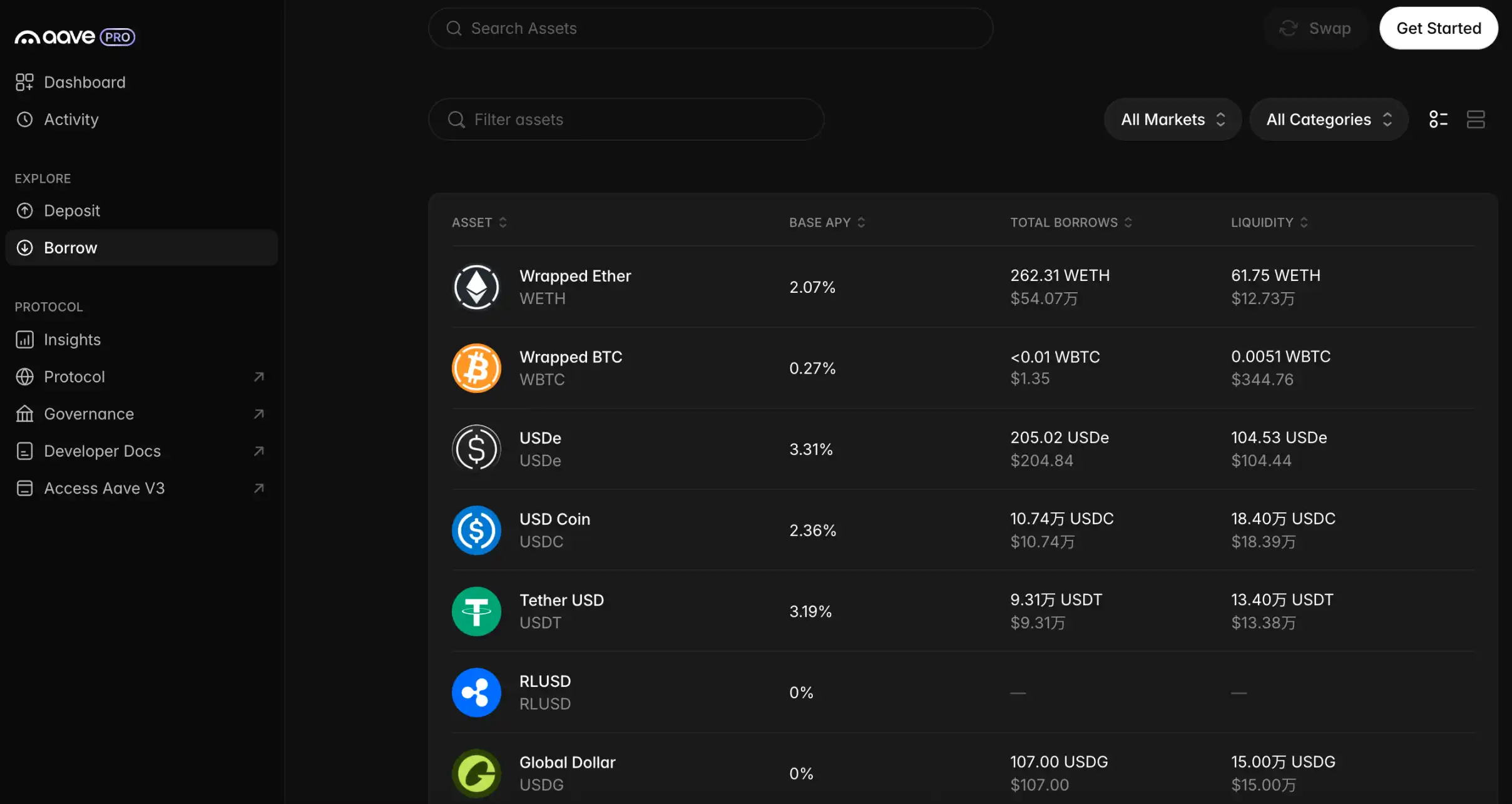
The V4 version can be seen as a complete overhaul of Aave, with the most fundamental change being the consolidation of the previously separate lending markets into a unified liquidity pool architecture: Hub and Spoke.
In the V4 version, each chain or L2 has a unified liquidity hub (the Hub), where all user deposits and assets available for lending are pooled together in a single liquidity pool. The Hub is responsible for global coordination, credit limit control, system-level constraints (such as "borrowing cap ≤ supply cap"), and emergency pausing. The Hub does not interact directly with users but rather manages liquidity in the background.
It is worth noting that each chain does not have only one Hub; instead, different Hubs are designed based on different needs, fundamentally serving as a form of risk isolation. For example, V4 has currently launched the Core Hub, Prime Hub, and Plus Hub. The Core Hub includes mainstream assets and is open to all users, the Prime Hub is designed for suppliers looking for more "controlled" collateral. The Plus Hub is designed for stablecoin pools and its parameter design needs to consider the project's scale.
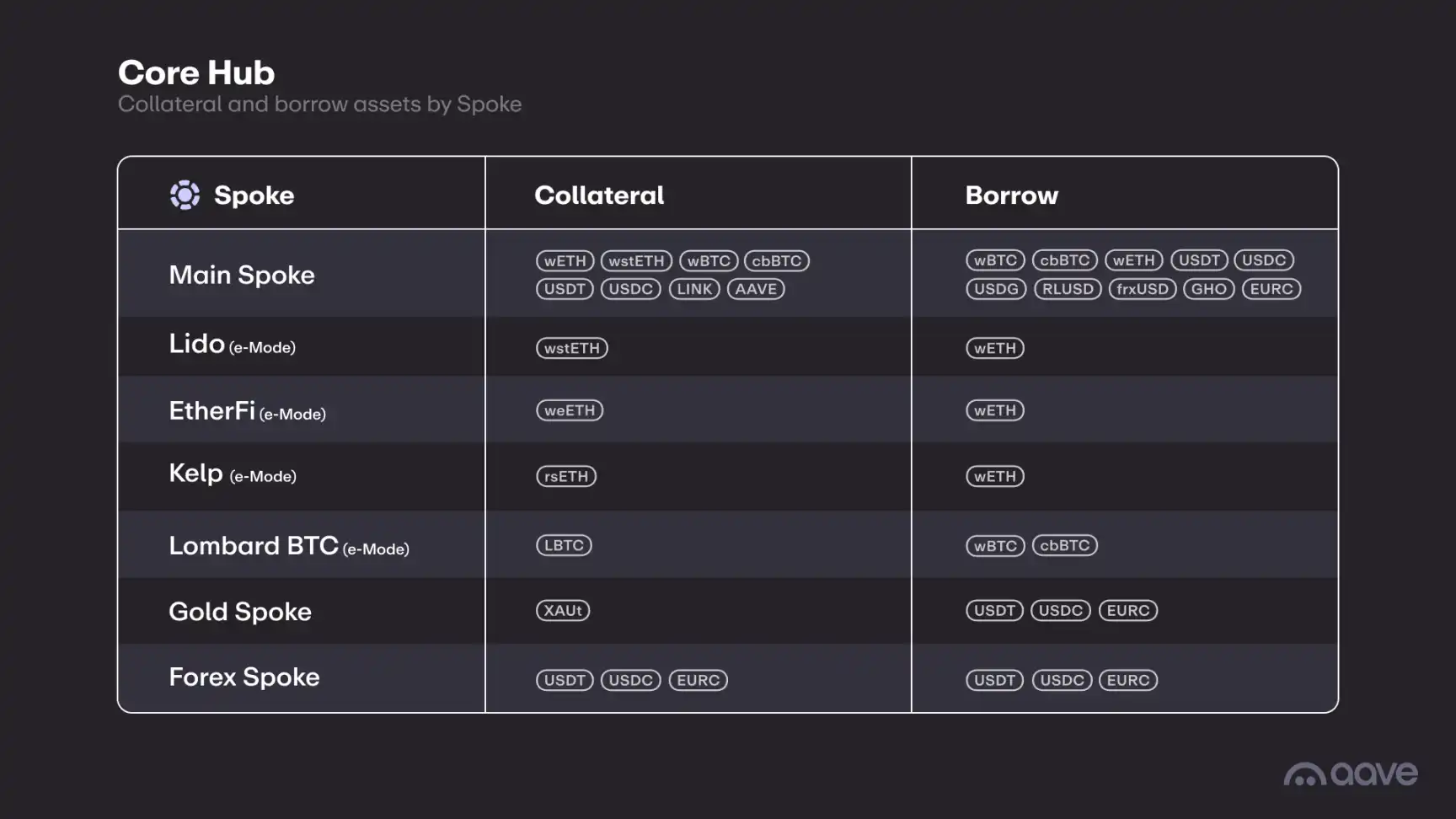
As for Spokes, you can think of them as independent markets, each with its own lending functions, risk parameters, and collateral rules. Within a Hub, users' assets are pooled together in the same liquidity pool, and borrowers need to select different Spokes based on their needs. For example, as shown in the diagram, users can deposit WETH as an asset available for borrowing, and borrowers can borrow WETH in the first four Spokes, but only the EtherFi Spoke allows weETH as collateral.
While the official statement claims to integrate fragmented liquidity, in practice, there is not much difference for users borrowing against high-quality collateral. For example, if you want to collateralize ETH to borrow assets, there is no difference in operation between V3 and V4, as long as you can ensure the health factor is not too low.
So, in terms of liquidity aggregation, V4 is indeed more sophisticated than managing standalone markets, but it's not a qualitative leap. The real difference comes from Spoke's customized parameters and the new liquidation engine.
In V4, a borrower's interest rate depends on the base rate and risk premium. The base rate still follows the utilization curve as in V3, where it slowly rises below optimal utilization and sharply rises above it. The risk premium depends on the nature of the collateral asset. For stable assets like USDT, ETH, WBTC, the risk premium may be very small or even 0. However, high-risk assets like altcoins will have a high risk premium to avoid a "good asset subsidizing bad assets" scenario.
For a simple example, in V3, the interest rate solely depended on supply and demand. When lending out USDT, even though the loan-to-value (LTV) and liquidation threshold may vary, the interest rate for collateralizing ETH and LINK under the same supply and demand conditions was the same, even though LINK’s price volatility is higher than ETH's. If the rates are the same and a LINK borrower increases utilization, it could lead to ETH collateral users facing higher borrowing costs.
V4 has optimized this flaw. Users borrowing against high-risk assets will incur higher costs, allowing fund providers to earn higher returns. The higher rates also limit borrowing demand, emphasizing the cost advantage for users borrowing against high-quality assets.
Regarding the liquidation mechanism, liquidators will only bring the health factor back to Spoke's preset target value, and the lower the health factor, the higher the liquidation bonus. This design not only provides borrowers with greater flexibility but also reduces the platform's default risk. Additionally, the new liquidation engine introduces an "anti-dust mechanism," where if the remaining debt or collateral falls below a threshold (e.g., $1000), liquidators must fully liquidate the position to prevent small residual amounts from undermining fund efficiency.
Lastly, idle liquidity in the Hub can automatically be allocated to governance-approved low-risk yield strategies (such as short-term government bonds, stablecoin LPs, money market tools). This increases income for liquidity suppliers and also boosts the DAO's revenue, which may be one of the few advantages of "Unified Liquidity."
Overall, the advantages of Aave V4's Unified Liquidity in lending are not significant, and the so-called composability, where borrowing users can efficiently manage positions across different Spokes, is not much more convenient than V3. But as the author stated in the title, V4 has transformed Aave from a product into a financial infrastructure resembling a "bank."
Setting aside various complex businesses, the core business of a bank is to accept deposits, retain a portion as reserve for users' daily payment, transfer, and other needs, and then earn the spread through lending. As for idle funds, banks can also allocate them to different investments within the limits of risk tolerance.

Banca San Giorgio Headquarters in Palazzo San Giorgio
Founded in 1407 in Genoa, Italy, Banca San Giorgio is generally considered the world's earliest bank. The bank not only provided deposit and loan services but also engaged in government debt management, currency exchange, fund transfers, and other businesses, meeting the commercial needs of Genoa as a key trading center in Europe at that time.
From the launch of ETHLend in 2017 to the release of Aave V4 in 2026, in less than 10 years, Aave has evolved to resemble the original concept of a bank. Of course, the differences between Aave and a bank are significant, and this is just a metaphor. Compared to P2P, the centuries-old model of a bank that has weathered countless black swan events is naturally a better choice, just as V4 is to V3.
If you observe closely, you will notice that a substantial amount of the "innovations" in the DeFi space has almost turned into historical dust, such as the hot trend of DeFi 2.0 in the second half of 2021. Instead, projects like Aave, with simple business models whose logic has matured over several hundred years in traditional finance, have not only survived but thrived. After many years of exploration, many DeFi projects have encountered a common realization: while DeFi's potential is immense, not a single step of the path traversed by traditional finance can be omitted.
Aave V4 consolidates liquidity, paving the way for a myriad of future possibilities. For instance, it can take assets idle for a certain period (e.g., one year) and engage in relatively higher-risk investments, such as providing liquidity on Uniswap for pairs like ETH/USDT, operating entirely on a commercial bank model. It can gradually expand into other commercial bank services, such as credit cards (as seen in Ethfi's model of collateralized borrowing to spend stablecoins), and so on.
Furthermore, Aave can further expand into an "investment bank." For example, by launching an ICO platform, users earning interest on deposited assets can lend out USDT, USDC to participate in investments without the need to withdraw assets to sell and exchange for stablecoins to join ICOs. This way, they can collect fees from projects while earning interest.
While the Hub & Spoke mechanism itself does not bring much innovation to lending per se, it lays the most important groundwork for the next steps.
You may also like

The impossible triangle is simply a pseudo problem

Stablecoins Finally Find Real Returns: On-Chain Reinsurance Re Explained | Interview with Re Founder Karan Saroya

The AI gamble of mining companies: Valuations enter a phase of differentiation, and it's hard to turn the tide

A letter from Alliance to entrepreneurs: Written on the occasion of Cursor selling for 60 billion dollars

Will MicroStrategy fall into a death spiral? What will the macro trend be in the second half of the year?

Blockchain Capital Partner: The Core Secret of Arbitrage

STRC unanchored by 11%, can the perpetual motion machine of Strategy still operate?

Bitcoin Market Analysis 2026: Can BTC Reach $150K by Year-End?

Bitcoin ETF Outflows Hit a Record $4.4 Billion: What Are Traders Doing With Their Cash?

WEEX App Just Got Smarter – New Tabs for Faster Trades & Easy Asset Management

WEEX All-New Search Features: Find, Trade & Earn Faster Than Ever

Morning Report | Illinois signs the strictest digital asset tax law in the U.S.; RWA tokenization market size surpasses $43 billion, institutions accelerate the migration of on-chain assets

Full version of the debut Q&A! Federal Reserve Chairman Waller: Sticking to the 2% inflation target, establishing five special working groups, individual did not submit the dot plot

From Disruptor to Shadow Market: The Crypto Market is Becoming a Colony of Traditional Finance
Dalio's important long article: How to position in the current market environment?
OKX Star analyzes Binance's competitive advantages: when regulation levels the playing field, competition has just begun

New gameplay for participating in initial offerings on cryptocurrency exchanges
Why Is Bitcoin Down Today? What the Hawkish FOMC Means for SpaceX, Gold and Nasdaq
The impossible triangle is simply a pseudo problem
Stablecoins Finally Find Real Returns: On-Chain Reinsurance Re Explained | Interview with Re Founder Karan Saroya
The AI gamble of mining companies: Valuations enter a phase of differentiation, and it's hard to turn the tide
A letter from Alliance to entrepreneurs: Written on the occasion of Cursor selling for 60 billion dollars
Will MicroStrategy fall into a death spiral? What will the macro trend be in the second half of the year?
Blockchain Capital Partner: The Core Secret of Arbitrage


