
- Buy Crypto
- Markets
 Futures
- Spot
- Copy Trade
 Earn
Earn- More
Market Prediction and Emerging Parataxis: What is the current major challenge?

Original Title: "Jsquare Report on 'Prediction Markets and Emerging Oracles'"
Original Source: Jsquare Investment Team
Prediction markets (also known as event derivatives) are markets where participants buy and sell contracts based on the outcome of future events. In these markets, the contract price reflects the public's judgment of the probability of a particular event occurring. Prediction markets aggregate dispersed information, allowing a large number of independent traders to collectively form highly accurate predictions, often with more advantage than a single expert or traditional poll. A typical form is a binary option, where a fixed amount (e.g., $1) is paid if the event occurs, and $0 is paid if it does not; thus, the trading price of the option in cents directly represents the market's view of the probability of the event occurring.
This mechanism provides a real-time updating odds indicator, reflecting market expectations instantly as news changes, making the price discovery process of events such as politics, sports, and finance more efficient and continuous.
Development History of Prediction Markets
Historically, pioneers like Betfair (founded in 2000) set a precedent for prediction markets, allowing users to bet peer-to-peer on sports events or political outcomes without having to bet against a bookmaker. As early as 1988, academic projects like the Iowa Electronic Markets had already validated this concept, accurately predicting U.S. election results through small-scale trades. By the 2000s, platforms like InTrade, based in Ireland, became a popular real-money market for politics and other events, but due to regulatory issues, the platform was forced to shut down in 2013.
Early decentralized platforms, such as Augur (the first Ethereum-based prediction protocol launched in 2018), demonstrated the potential to trade events trustlessly, offering binary, categorical, and scalar markets on an open network. However, Augur's on-chain design posed issues like slow speed, low liquidity, and poor usability, limiting its adoption. In recent years, emerging platforms like Polymarket have focused more on user experience (fast transactions, sleek interface) and low fees, gaining broader user acceptance. Consequently, prediction markets gradually entered the mainstream between 2024 and 2025, attracting hundreds of thousands of users, with trading volumes reaching billions of dollars.
Evolution of Trading Volumes
Modern prediction markets have experienced significant growth from niche to large-scale development. Early instances were very small in scale: the Iowa Electronic Markets in 1988 had an investment limit of only $500 but proved its accuracy in predicting U.S. elections. Internet exchanges in the 2000s began to show real trading volumes, such as InTrade. By the 2012 U.S. election, InTrade had over 82,000 users, with the betting volume exceeding $200 million for just that election. InTrade's rapid growth demonstrated market demand but also attracted regulatory pressure—the Commodity Futures Trading Commission (CFTC) sued it for operating an unregistered exchange at the end of 2012, leading to a ban on U.S. users and ultimately the platform's closure.
In the sports betting domain, the Betfair Exchange (launched in the UK in 2000) has steadily accumulated liquidity and by the 2010s had become the largest global market for sports and political event predictions. The 2020 US Presidential election was a milestone for Betfair, with the matched betting volume for that single market alone exceeding £4.8 billion. As a comparison, the over $6 billion in traded volume far surpassed previous election markets, showing a continued trend of rising interest with each election cycle.
The trading volume of native crypto prediction markets remained relatively small until 2020. Although Augur launched in 2018 and once garnered significant attention (its Fully Diluted Valuation (FDV) once exceeded $10 billion), actual usage has always been limited and hindered by high Ethereum gas fees and complex user experience. Augur's trading volume has never exceeded a few million dollars, and its market liquidity is dispersed.
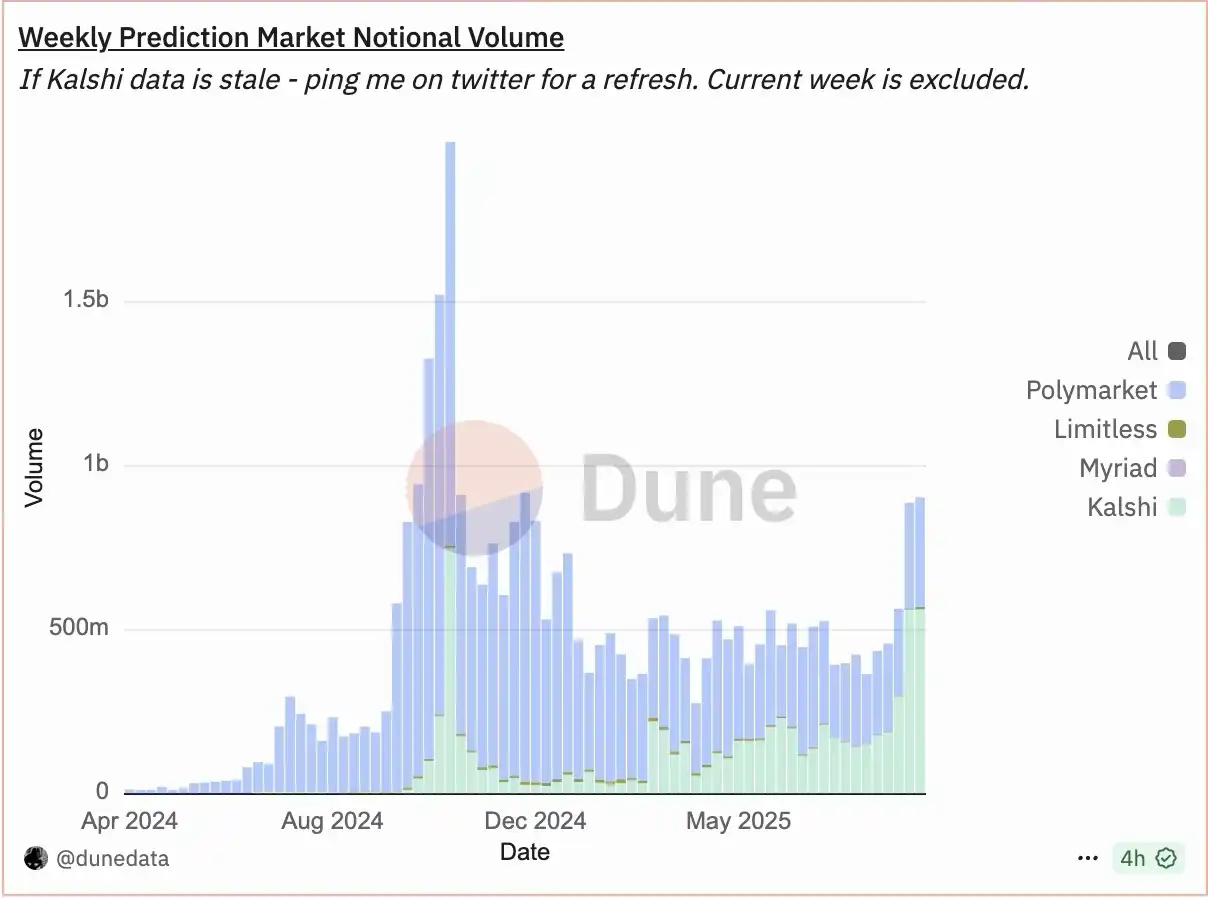
Changing the game is Polymarket, which was launched in 2020, focusing on transaction speed, user experience, and low barriers to entry. Polymarket quickly rose to become the dominant platform in crypto prediction markets, especially excelling during major news events. Its trading activity surged during the US election cycle. For example, during the 2024 presidential election period, Polymarket's trading volume in the single month of November 2024 exceeded $25 billion. By the end of 2024, Polymarket had processed a total trading volume of around $90 billion and amassed over 300,000 users, making it the largest prediction market globally to date.
Kalshi is a prediction market exchange that has received approval from the CFTC (US Commodity Futures Trading Commission) and was launched in 2021. Its rapid growth while fully compliant with the US regulatory framework is highly noteworthy. The graph below shows Kalshi's nominal trading volume growth curve.
The Biggest Challenges Facing the Field
Despite making progress, the prediction market still faces several long-standing challenges that hinder its attainment of a position comparable to traditional financial markets.
1. Regulatory Uncertainty and Legal Barriers
By far the most significant barrier to date has been regulatory issues. In many jurisdictions, prediction markets involving real money are legally seen as gambling or unregistered financial exchanges. Early crypto platforms attempted to circumvent these regulations through offshore operations or by operating as decentralized protocols, but they have also faced penalties as a result (for example, Polymarket was fined $1.4 million by the CFTC in 2022 and barred from serving US users). Globally, jurisdictions have varied stances: some countries (like the UK through Betfair) allow regulated exchanges to facilitate event betting, while others completely ban public event betting. This fragmented legal landscape creates uncertainty, forcing many prediction market projects to operate in gray areas or launch with regional restrictions. Even as federal regulators show signs of easing their stance (notably, the CFTC issued a no-action letter in September 2025 allowing a related company of Polymarket to legally operate event markets in the US), state-level regulations could still pose obstacles—recently, Robinhood attempted to enter the event market but was halted by regulatory agencies in states like Nevada and New Jersey.
2. Liquidity and Market Depth
In order for the market to produce accurate probability pricing and attract genuine investors, sufficient liquidity is a prerequisite. Most prediction markets, apart from a few flagship events, often struggle to maintain adequate liquidity. We often see a brief surge in trading volume followed by a rapid decline— for example, after the 2024 U.S. election results were announced, Polymarket saw an 84% overnight drop in user activity and trading volume as traders exited en masse post-major event. Smaller or niche markets are more prone to issues such as large bid-ask spreads and low participation, making them not only susceptible to manipulation but also disinteresting for traders.
3. Oracle and Settlement Challenges
Since prediction markets revolve around real-world events, a reliable mechanism is needed to determine event outcomes. Decentralized markets have experimented with various solutions, each with its own set of issues. Augur's model relies on REP token holders to report outcomes and resolves disputes through a forking mechanism. While this model is decentralized, settlement in disputed events may take weeks, and theoretically, if a malicious actor holds a significant amount of REP, the market could be manipulated. Next-generation systems utilize optimistic oracles or external data sources; for example, Polymarket leverages UMA's optimistic oracle, where the result is assumed true once submitted unless challenged within a specified time window. This speeds up settlement for the majority but still relies on a set of trusted challengers and can face issues if the data itself is ambiguous. Centralized platforms (e.g., PredictIt, Betfair, Kalshi) typically rely on internal team decisions or preset news sources to determine outcomes, but this also carries trust risks.
Potential Emerging New Primitives
To overcome current limitations, prediction market projects are experimenting with new primitives and mechanisms.
1. Prediction Derivatives Markets
An evident trend is to create derivatives on top of prediction markets, allowing traders to leverage bet on event outcomes similar to trading stock futures or options. In traditional finance, the derivatives market is often much larger than the spot market, so introducing this concept to prediction markets could significantly boost overall trading volume and liquidity.
2. Advanced Automated Market Makers and Liquidity Mechanisms
We can expect to see tailored improvements to market-making primitives specifically designed for event markets. While standard constant product automated market makers (AMMs) can provide basic liquidity, they are not ideal for binary prediction markets due to their low capital efficiency and susceptibility to high slippage in large trades. It is more likely that new AMM formulas will be deployed in the future, such as dynamic concentrated liquidity or adjusted variants of the logarithmic market scoring rule (LMSR), to enhance and optimize liquidity.
3. Interoperability Paradigms
As the ecosystem matures, interoperability between prediction market platforms and other DeFi protocols will become a key development direction. For example, using prediction market outcome tokens as collateral in lending protocols—meaning users can collateralize these tokens to borrow stablecoins based on the computed expected value of their betting combination. Additionally, we may see tranched or index-like structured products: issuing index tokens representing a basket of outcome tokens (similar to a "prediction market ETF") that can be freely traded on secondary markets or used to make broad bets on a particular theme.
Prediction Market Investment Opportunities
1. Derivatives Market
A derivatives market built on top of prediction markets may be the next trend in the field. Such projects include perpetual contracts, options, or other leveraged financial instruments based on event outcomes. The core idea is simple: in mature financial systems, derivative trading far exceeds spot trading, and prediction markets are also poised to follow a similar growth trajectory in the future.
· Gondor: A DeFi lending protocol tailored to prediction market traders. By allowing users to collateralize their positions without closing their Polymarket positions, Gondor unlocks liquidity for prediction market traders. Users deposit YES/NO shares as collateral to borrow stablecoins; the protocol dynamically adjusts the LTV (loan-to-value ratio) based on market probabilities and triggers automatic liquidation, enhancing capital efficiency for longer-duration event markets.
· D8X: A next-generation on-chain futures protocol designed for leveraged prediction markets. D8X introduces order-book-based event outcome perpetual contracts, combining encrypted prediction markets with high-leverage trading. D8X focuses on addressing the unique volatility issue of $0–$1 event contracts, aiming to unleash derivatives trading volume for various events ranging from political elections to sports events, viewing "event leverage trading" as a natural evolution direction for the prediction market industry.
· dYdX: The leading decentralized perpetual contract exchange dYdX is also entering the event market field. Its V4 upgrade will open permissionless binary event markets on a standalone application chain, allowing users to trade real-world events with leverage through perpetual contracts. To support event settlement, dYdX introduces a shared liquidity pool MegaVault and an on-chain oracle mechanism.
· Aura: A protocol offering leveraged trading on event outcomes. It allows users to make directional leveraged trades on real-world narratives (elections, sports, crypto events) through perpetual-style contracts. Aura is natively built on top of Hyperliquid, leveraging its unified margin system to achieve deep liquidity and low-latency matching while accessing Polymarket data as a settlement reference.
· Polyindex: A prediction market index protocol that allows users to create an ERC-20 index token consisting of multiple Polymarket event contracts. Index creators select a set of event IDs and set weights, and the protocol continuously syncs Polymarket's market prices, liquidity, and event outcomes. Users only need to hold a single token to gain exposure to a basket of events; as the underlying events settle, the index also automatically settles.
2. Permissionless Market Creation
The most powerful growth lever of prediction markets is the ability for anyone to create and trade new markets without intermediaries. Such projects provide infrastructure for user-generated event markets covering everything from politics and crypto prices to niche community predictions. This unleashes index-level innovation space, similar to the liquidity democratization Uniswap achieved in DeFi. By lowering the market deployment threshold, these protocols can surpass the scale of any centralized prediction platform, turning every narrative, event, or data source into a tradable market.
· Augur: A groundbreaking protocol launched in 2018 that validated the concept of user-created prediction markets. Augur V2 supports markets ranging from elections to sports without centralized approval, with a cumulative trading volume exceeding $100 million by 2025. However, its early versions faced challenges in user experience and liquidity, paving the way for the development of better solutions later on.
· The Clearing Company: Founded by former Polymarket team members in 2025, aiming to build a regulated on-chain exchange for permissionless event contract trading. Its goal is to integrate decentralization with regulatory compliance, enabling anyone to create retail-focused event markets.
· Melee Markets: A recently funded startup that takes an innovative approach to building user-generated markets. On the Melee platform, "anyone can create a market about anything," covering objective event outcomes to opinion-based questions. Its innovation lies in the "viral market" mechanism, rewarding early bettors on trending issues, combining predictive certainty with social token growth potential.
· Kash: A social-native prediction protocol that embeds "lightning prediction markets" directly into social feeds, allowing users to predict on news events, narrative hotspots, or viral content without navigating away. Each market lasts 24 hours and settles automatically in USDC. Kash significantly lowers the interaction threshold through gas-free transactions and AI-driven trending events auto-generation, turning every social trend into a tradable market event.
· XO Market: A permissionless belief market platform where anyone can instantly create, trade, and settle binary event markets. The platform is built on a sovereign Rollup architecture to ensure a fast and transparent trading experience. It also introduces an adaptive liquidity curve and decentralized arbitration mechanism to guarantee fair settlement for both fact-based events and social narrative events.
3. Prediction Market Sports Betting
Sports betting is one of the world's largest betting markets and is now facing new challenges. Investing in sports prediction projects can tap into the vast sports fan user base, which inherently has a strong and stable investment intention. The unique selling point is clear: the prediction market operates 24/7, settles in real-time with stablecoins, and does not lock your position (you can cash out your bet before the end of the match).
· SX Network (SX Bet): One of the earliest decentralized sports betting platforms, founded in 2019. SX Bet initially ran on Ethereum and later migrated to the SX Chain, an Arbitrum-based independent chain. It adopts a peer-to-peer betting transaction model where users can hedge odds against each other (even allowing parlay bets across multiple matches). To date, this model has achieved over $350 million in cumulative betting volume. SX also introduced a native token ($SX) and "bet mining" rewards, allowing winning bettors to earn tokens and participate in platform governance—effectively making the community "the house" rather than a centralized betting company.
· BetDEX: A decentralized sports betting exchange co-founded by former FanDuel executives in 2021. Built on the Monaco protocol on Solana, BetDEX launched at the end of 2022, aiming to provide a global Betfair-like experience on the blockchain (low fees, high speed, and instant settlement of all bets). It is worth noting that it is the first Web3 sports betting platform to obtain a full gambling license—In November 2022, BetDEX obtained a full sports betting exchange license in the Isle of Man, allowing it to legally operate online gambling in approved jurisdictions.
· Aver: A Solana-based decentralized betting exchange that officially launched in mid-2022 after completing a $7.5 million seed funding round, with investors including Jump Trading and Susquehanna. Aver uses a fully on-chain order book (rather than AMM) to match bets on sports and other events, providing a low-latency trading experience close to Web2 platforms. The order matching, result settlement, and reward distribution in its betting process are all executed by Solana smart contracts, allowing users to autonomously manage funds and instantly withdraw earnings to their personal wallets after each event concludes.
· Frontrunner: A relatively new decentralized sports prediction market focused on American sports and esports. Frontrunner's platform (testnet launched at the end of 2022) presents sports betting in a stock market-like format: users buy and sell "shares" of teams or players in leagues such as the NFL, NBA, and Premier League through a trading interface. The platform plans to introduce index-like markets similar to ETFs (e.g., a basket of teams) and support stablecoin betting. Frontrunner is built on Injective (a Cosmos-based blockchain) to achieve zero gas fees and utilizes its built-in order book module for matching.
· Divvy: A Solana-based sports betting protocol that allows users to directly bet on major sports events' outcomes through a crypto wallet. All bets are held by decentralized smart contracts to enable instant, trustless payments at settlement. Its uniqueness lies in its use of community-driven liquidity pools as the opposing side of bets, where users can provide funds to this pool to serve as the house, earning a portion of the house's profits over time.
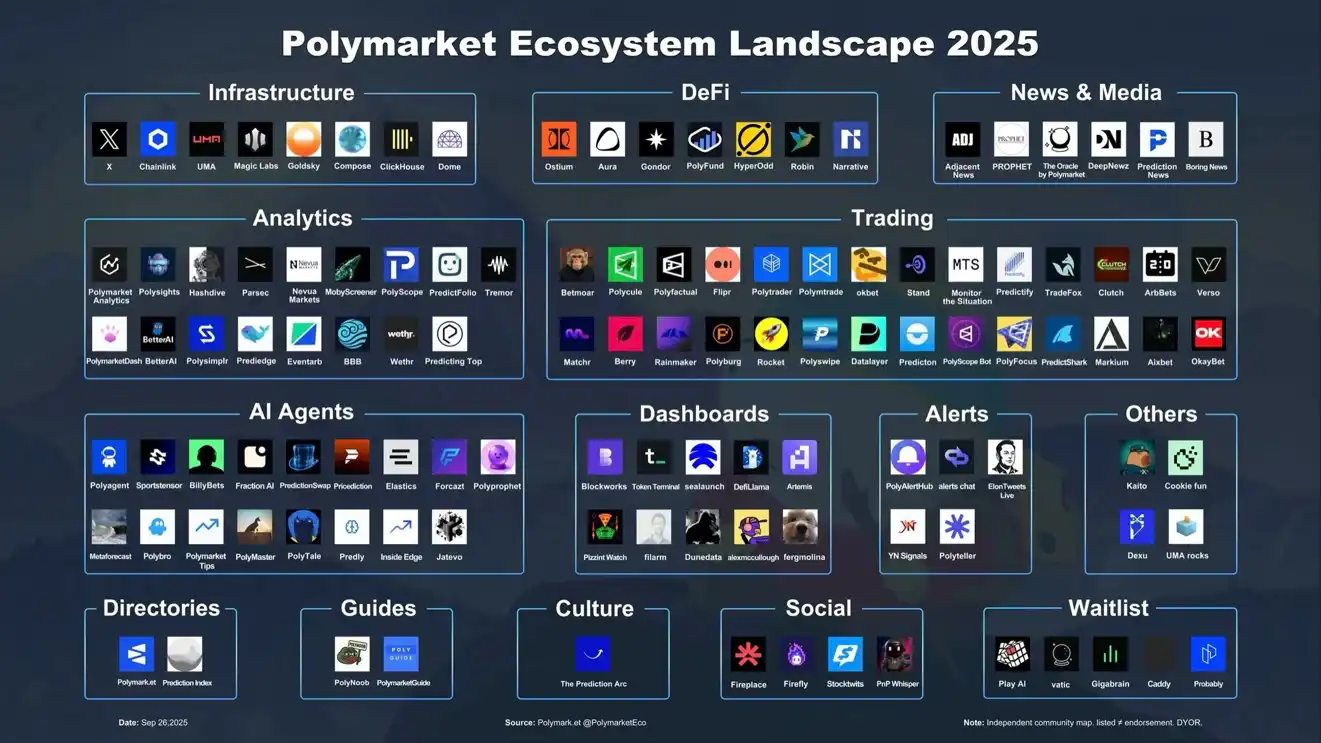
Project Ecosystem Map
Reference Material Sources:
coinshares.com
betting.betfair.com
medium.com
dlnews.com
blockworks.co
pymnts.com
newsletter.sportingcrypto.com
https://polymark.et/
This article is contributed content and does not represent the views of BlockBeats.
You may also like

Token Cannot Compound, Where Is the Real Investment Opportunity?

February 6th Market Key Intelligence, How Much Did You Miss?

China's Central Bank and Eight Other Departments' Latest Regulatory Focus: Key Attention to RWA Tokenized Asset Risk
Foreword: Today, the People's Bank of China's website published the "Notice of the People's Bank of China, National Development and Reform Commission, Ministry of Industry and Information Technology, Ministry of Public Security, State Administration for Market Regulation, China Banking and Insurance Regulatory Commission, China Securities Regulatory Commission, State Administration of Foreign Exchange on Further Preventing and Dealing with Risks Related to Virtual Currency and Others (Yinfa [2026] No. 42)", the latest regulatory requirements from the eight departments including the central bank, which are basically consistent with the regulatory requirements of recent years. The main focus of the regulation is on speculative activities such as virtual currency trading, exchanges, ICOs, overseas platform services, and this time, regulatory oversight of RWA has been added, explicitly prohibiting RWA tokenization, stablecoins (especially those pegged to the RMB). The following is the full text:
To the people's governments of all provinces, autonomous regions, and municipalities directly under the Central Government, the Xinjiang Production and Construction Corps:
Recently, there have been speculative activities related to virtual currency and Real-World Assets (RWA) tokenization, disrupting the economic and financial order and jeopardizing the property security of the people. In order to further prevent and address the risks related to virtual currency and Real-World Assets tokenization, effectively safeguard national security and social stability, in accordance with the "Law of the People's Republic of China on the People's Bank of China," "Law of the People's Republic of China on Commercial Banks," "Securities Law of the People's Republic of China," "Law of the People's Republic of China on Securities Investment Funds," "Law of the People's Republic of China on Futures and Derivatives," "Cybersecurity Law of the People's Republic of China," "Regulations of the People's Republic of China on the Administration of Renminbi," "Regulations on Prevention and Disposal of Illegal Fundraising," "Regulations of the People's Republic of China on Foreign Exchange Administration," "Telecommunications Regulations of the People's Republic of China," and other provisions, after reaching consensus with the Cyberspace Administration of China, the Supreme People's Court, and the Supreme People's Procuratorate, and with the approval of the State Council, the relevant matters are notified as follows:
(I) Virtual currency does not possess the legal status equivalent to fiat currency. Virtual currencies such as Bitcoin, Ether, Tether, etc., have the main characteristics of being issued by non-monetary authorities, using encryption technology and distributed ledger or similar technology, existing in digital form, etc. They do not have legal tender status, should not and cannot be circulated and used as currency in the market.
The business activities related to virtual currency are classified as illegal financial activities. The exchange of fiat currency and virtual currency within the territory, exchange of virtual currencies, acting as a central counterparty in buying and selling virtual currencies, providing information intermediary and pricing services for virtual currency transactions, token issuance financing, and trading of virtual currency-related financial products, etc., fall under illegal financial activities, such as suspected illegal issuance of token vouchers, unauthorized public issuance of securities, illegal operation of securities and futures business, illegal fundraising, etc., are strictly prohibited across the board and resolutely banned in accordance with the law. Overseas entities and individuals are not allowed to provide virtual currency-related services to domestic entities in any form.
A stablecoin pegged to a fiat currency indirectly fulfills some functions of the fiat currency in circulation. Without the consent of relevant authorities in accordance with the law and regulations, any domestic or foreign entity or individual is not allowed to issue a RMB-pegged stablecoin overseas.
(II)Tokenization of Real-World Assets refers to the use of encryption technology and distributed ledger or similar technologies to transform ownership rights, income rights, etc., of assets into tokens (tokens) or other interests or bond certificates with token (token) characteristics, and carry out issuance and trading activities.
Engaging in the tokenization of real-world assets domestically, as well as providing related intermediary, information technology services, etc., which are suspected of illegal issuance of token vouchers, unauthorized public offering of securities, illegal operation of securities and futures business, illegal fundraising, and other illegal financial activities, shall be prohibited; except for relevant business activities carried out with the approval of the competent authorities in accordance with the law and regulations and relying on specific financial infrastructures. Overseas entities and individuals are not allowed to illegally provide services related to the tokenization of real-world assets to domestic entities in any form.
(III) Inter-agency Coordination. The People's Bank of China, together with the National Development and Reform Commission, the Ministry of Industry and Information Technology, the Ministry of Public Security, the State Administration for Market Regulation, the China Banking and Insurance Regulatory Commission, the China Securities Regulatory Commission, the State Administration of Foreign Exchange, and other departments, will improve the work mechanism, strengthen coordination with the Cyberspace Administration of China, the Supreme People's Court, and the Supreme People's Procuratorate, coordinate efforts, and overall guide regions to carry out risk prevention and disposal of virtual currency-related illegal financial activities.
The China Securities Regulatory Commission, together with the National Development and Reform Commission, the Ministry of Industry and Information Technology, the Ministry of Public Security, the People's Bank of China, the State Administration for Market Regulation, the China Banking and Insurance Regulatory Commission, the State Administration of Foreign Exchange, and other departments, will improve the work mechanism, strengthen coordination with the Cyberspace Administration of China, the Supreme People's Court, and the Supreme People's Procuratorate, coordinate efforts, and overall guide regions to carry out risk prevention and disposal of illegal financial activities related to the tokenization of real-world assets.
(IV) Strengthening Local Implementation. The people's governments at the provincial level are overall responsible for the prevention and disposal of risks related to virtual currencies and the tokenization of real-world assets in their respective administrative regions. The specific leading department is the local financial regulatory department, with participation from branches and dispatched institutions of the State Council's financial regulatory department, telecommunications regulators, public security, market supervision, and other departments, in coordination with cyberspace departments, courts, and procuratorates, to improve the normalization of the work mechanism, effectively connect with the relevant work mechanisms of central departments, form a cooperative and coordinated working pattern between central and local governments, effectively prevent and properly handle risks related to virtual currencies and the tokenization of real-world assets, and maintain economic and financial order and social stability.
(5) Enhanced Risk Monitoring. The People's Bank of China, China Securities Regulatory Commission, National Development and Reform Commission, Ministry of Industry and Information Technology, Ministry of Public Security, State Administration of Foreign Exchange, Cyberspace Administration of China, and other departments continue to improve monitoring techniques and system support, enhance cross-departmental data analysis and sharing, establish sound information sharing and cross-validation mechanisms, promptly grasp the risk situation of activities related to virtual currency and real-world asset tokenization. Local governments at all levels give full play to the role of local monitoring and early warning mechanisms. Local financial regulatory authorities, together with branches and agencies of the State Council's financial regulatory authorities, as well as departments of cyberspace and public security, ensure effective connection between online monitoring, offline investigation, and fund tracking, efficiently and accurately identify activities related to virtual currency and real-world asset tokenization, promptly share risk information, improve early warning information dissemination, verification, and rapid response mechanisms.
(6) Strengthened Oversight of Financial Institutions, Intermediaries, and Technology Service Providers. Financial institutions (including non-bank payment institutions) are prohibited from providing account opening, fund transfer, and clearing services for virtual currency-related business activities, issuing and selling financial products related to virtual currency, including virtual currency and related financial products in the scope of collateral, conducting insurance business related to virtual currency, or including virtual currency in the scope of insurance liability. Financial institutions (including non-bank payment institutions) are prohibited from providing custody, clearing, and settlement services for unauthorized real-world asset tokenization-related business and related financial products. Relevant intermediary institutions and information technology service providers are prohibited from providing intermediary, technical, or other services for unauthorized real-world asset tokenization-related businesses and related financial products.
(7) Enhanced Management of Internet Information Content and Access. Internet enterprises are prohibited from providing online business venues, commercial displays, marketing, advertising, or paid traffic diversion services for virtual currency and real-world asset tokenization-related business activities. Upon discovering clues of illegal activities, they should promptly report to relevant departments and provide technical support and assistance for related investigations and inquiries. Based on the clues transferred by the financial regulatory authorities, the cyberspace administration, telecommunications authorities, and public security departments should promptly close and deal with websites, mobile applications (including mini-programs), and public accounts engaged in virtual currency and real-world asset tokenization-related business activities in accordance with the law.
(8) Strengthened Entity Registration and Advertisement Management. Market supervision departments strengthen entity registration and management, and enterprise and individual business registrations must not contain terms such as "virtual currency," "virtual asset," "cryptocurrency," "crypto asset," "stablecoin," "real-world asset tokenization," or "RWA" in their names or business scopes. Market supervision departments, together with financial regulatory authorities, legally enhance the supervision of advertisements related to virtual currency and real-world asset tokenization, promptly investigating and handling relevant illegal advertisements.
(IX) Continued Rectification of Virtual Currency Mining Activities. The National Development and Reform Commission, together with relevant departments, strictly controls virtual currency mining activities, continuously promotes the rectification of virtual currency mining activities. The people's governments of various provinces take overall responsibility for the rectification of "mining" within their respective administrative regions. In accordance with the requirements of the National Development and Reform Commission and other departments in the "Notice on the Rectification of Virtual Currency Mining Activities" (NDRC Energy-saving Building [2021] No. 1283) and the provisions of the "Guidance Catalog for Industrial Structure Adjustment (2024 Edition)," a comprehensive review, investigation, and closure of existing virtual currency mining projects are conducted, new mining projects are strictly prohibited, and mining machine production enterprises are strictly prohibited from providing mining machine sales and other services within the country.
(X) Severe Crackdown on Related Illegal Financial Activities. Upon discovering clues to illegal financial activities related to virtual currency and the tokenization of real-world assets, local financial regulatory authorities, branches of the State Council's financial regulatory authorities, and other relevant departments promptly investigate, determine, and properly handle the issues in accordance with the law, and seriously hold the relevant entities and individuals legally responsible. Those suspected of crimes are transferred to the judicial authorities for processing according to the law.
(XI) Severe Crackdown on Related Illegal and Criminal Activities. The Ministry of Public Security, the People's Bank of China, the State Administration for Market Regulation, the China Banking and Insurance Regulatory Commission, the China Securities Regulatory Commission, as well as judicial and procuratorial organs, in accordance with their respective responsibilities, rigorously crack down on illegal and criminal activities related to virtual currency, the tokenization of real-world assets, such as fraud, money laundering, illegal business operations, pyramid schemes, illegal fundraising, and other illegal and criminal activities carried out under the guise of virtual currency, the tokenization of real-world assets, etc.
(XII) Strengthen Industry Self-discipline. Relevant industry associations should enhance membership management and policy advocacy, based on their own responsibilities, advocate and urge member units to resist illegal financial activities related to virtual currency and the tokenization of real-world assets. Member units that violate regulatory policies and industry self-discipline rules are to be disciplined in accordance with relevant self-regulatory management regulations. By leveraging various industry infrastructure, conduct risk monitoring related to virtual currency, the tokenization of real-world assets, and promptly transfer issue clues to relevant departments.
(XIII) Without the approval of relevant departments in accordance with the law and regulations, domestic entities and foreign entities controlled by them may not issue virtual currency overseas.
(XIV) Domestic entities engaging directly or indirectly in overseas external debt-based tokenization of real-world assets, or conducting asset securitization activities abroad based on domestic ownership rights, income rights, etc. (hereinafter referred to as domestic equity), should be strictly regulated in accordance with the principles of "same business, same risk, same rules." The National Development and Reform Commission, the China Securities Regulatory Commission, the State Administration of Foreign Exchange, and other relevant departments regulate it according to their respective responsibilities. For other forms of overseas real-world asset tokenization activities based on domestic equity by domestic entities, the China Securities Regulatory Commission, together with relevant departments, supervise according to their division of responsibilities. Without the consent and filing of relevant departments, no unit or individual may engage in the above-mentioned business.
(15) Overseas subsidiaries and branches of domestic financial institutions providing Real World Asset Tokenization-related services overseas shall do so legally and prudently. They shall have professional personnel and systems in place to effectively mitigate business risks, strictly implement customer onboarding, suitability management, anti-money laundering requirements, and incorporate them into the domestic financial institutions' compliance and risk management system. Intermediaries and information technology service providers offering Real World Asset Tokenization services abroad based on domestic equity or conducting Real World Asset Tokenization business in the form of overseas debt for domestic entities directly or indirectly venturing abroad must strictly comply with relevant laws and regulations. They should establish and improve relevant compliance and internal control systems in accordance with relevant normative requirements, strengthen business and risk control, and report the business developments to the relevant regulatory authorities for approval or filing.
(16) Strengthen organizational leadership and overall coordination. All departments and regions should attach great importance to the prevention of risks related to virtual currencies and Real World Asset Tokenization, strengthen organizational leadership, clarify work responsibilities, form a long-term effective working mechanism with centralized coordination, local implementation, and shared responsibilities, maintain high pressure, dynamically monitor risks, effectively prevent and mitigate risks in an orderly and efficient manner, legally protect the property security of the people, and make every effort to maintain economic and financial order and social stability.
(17) Widely carry out publicity and education. All departments, regions, and industry associations should make full use of various media and other communication channels to disseminate information through legal and policy interpretation, analysis of typical cases, and education on investment risks, etc. They should promote the illegality and harm of virtual currencies and Real World Asset Tokenization-related businesses and their manifestations, fully alert to potential risks and hidden dangers, and enhance public awareness and identification capabilities for risk prevention.
(18) Engaging in illegal financial activities related to virtual currencies and Real World Asset Tokenization in violation of this notice, as well as providing services for virtual currencies and Real World Asset Tokenization-related businesses, shall be punished in accordance with relevant regulations. If it constitutes a crime, criminal liability shall be pursued according to the law. For domestic entities and individuals who knowingly or should have known that overseas entities illegally provided virtual currency or Real World Asset Tokenization-related services to domestic entities and still assisted them, relevant responsibilities shall be pursued according to the law. If it constitutes a crime, criminal liability shall be pursued according to the law.
(19) If any unit or individual invests in virtual currencies, Real World Asset Tokens, and related financial products against public order and good customs, the relevant civil legal actions shall be invalid, and any resulting losses shall be borne by them. If there are suspicions of disrupting financial order and jeopardizing financial security, the relevant departments shall deal with them according to the law.
This notice shall enter into force upon the date of its issuance. The People's Bank of China and ten other departments' "Notice on Further Preventing and Dealing with the Risks of Virtual Currency Trading Speculation" (Yinfa [2021] No. 237) is hereby repealed.

Former Partner's Perspective on Multicoin: Kyle's Exit, But the Game He Left Behind Just Getting Started
Why Bitcoin Is Falling Now: The Real Reasons Behind BTC's Crash & WEEX's Smart Profit Playbook
Bitcoin's ongoing crash explained: Discover the 5 hidden triggers behind BTC's plunge & how WEEX's Auto Earn and Trade to Earn strategies help traders profit from crypto market volatility.

Wall Street's Hottest Trades See Exodus

Vitalik Discusses Ethereum Scaling Path, Circle Announces Partnership with Polymarket, What's the Overseas Crypto Community Talking About Today?

Believing in the Capital Markets - The Essence and Core Value of Cryptocurrency

Polymarket's 'Weatherman': Predict Temperature, Win Million-Dollar Payout

$15K+ Profits: The 4 AI Trading Secrets WEEX Hackathon Prelim Winners Used to Dominate Volatile Crypto Markets
How WEEX Hackathon's top AI trading strategies made $15K+ in crypto markets: 4 proven rules for ETH/BTC trading, market structure analysis, and risk management in volatile conditions.

A nearly 20% one-day plunge, how long has it been since you last saw a $60,000 Bitcoin?

Raoul Pal: I've seen every single panic, and they are never the end.

Key Market Information Discrepancy on February 6th - A Must-Read! | Alpha Morning Report

2026 Crypto Industry's First Snowfall
The Harsh Reality Behind the $26 Billion Crypto Liquidation: Liquidity Is Killing the Market
Why Is Gold, US Stocks, Bitcoin All Falling?

Key Market Intelligence for February 5th, how much did you miss out on?

Wintermute: By 2026, crypto had gradually become the settlement layer of the Internet economy
Token Cannot Compound, Where Is the Real Investment Opportunity?
February 6th Market Key Intelligence, How Much Did You Miss?
China's Central Bank and Eight Other Departments' Latest Regulatory Focus: Key Attention to RWA Tokenized Asset Risk
Foreword: Today, the People's Bank of China's website published the "Notice of the People's Bank of China, National Development and Reform Commission, Ministry of Industry and Information Technology, Ministry of Public Security, State Administration for Market Regulation, China Banking and Insurance Regulatory Commission, China Securities Regulatory Commission, State Administration of Foreign Exchange on Further Preventing and Dealing with Risks Related to Virtual Currency and Others (Yinfa [2026] No. 42)", the latest regulatory requirements from the eight departments including the central bank, which are basically consistent with the regulatory requirements of recent years. The main focus of the regulation is on speculative activities such as virtual currency trading, exchanges, ICOs, overseas platform services, and this time, regulatory oversight of RWA has been added, explicitly prohibiting RWA tokenization, stablecoins (especially those pegged to the RMB). The following is the full text:
To the people's governments of all provinces, autonomous regions, and municipalities directly under the Central Government, the Xinjiang Production and Construction Corps:
Recently, there have been speculative activities related to virtual currency and Real-World Assets (RWA) tokenization, disrupting the economic and financial order and jeopardizing the property security of the people. In order to further prevent and address the risks related to virtual currency and Real-World Assets tokenization, effectively safeguard national security and social stability, in accordance with the "Law of the People's Republic of China on the People's Bank of China," "Law of the People's Republic of China on Commercial Banks," "Securities Law of the People's Republic of China," "Law of the People's Republic of China on Securities Investment Funds," "Law of the People's Republic of China on Futures and Derivatives," "Cybersecurity Law of the People's Republic of China," "Regulations of the People's Republic of China on the Administration of Renminbi," "Regulations on Prevention and Disposal of Illegal Fundraising," "Regulations of the People's Republic of China on Foreign Exchange Administration," "Telecommunications Regulations of the People's Republic of China," and other provisions, after reaching consensus with the Cyberspace Administration of China, the Supreme People's Court, and the Supreme People's Procuratorate, and with the approval of the State Council, the relevant matters are notified as follows:
(I) Virtual currency does not possess the legal status equivalent to fiat currency. Virtual currencies such as Bitcoin, Ether, Tether, etc., have the main characteristics of being issued by non-monetary authorities, using encryption technology and distributed ledger or similar technology, existing in digital form, etc. They do not have legal tender status, should not and cannot be circulated and used as currency in the market.
The business activities related to virtual currency are classified as illegal financial activities. The exchange of fiat currency and virtual currency within the territory, exchange of virtual currencies, acting as a central counterparty in buying and selling virtual currencies, providing information intermediary and pricing services for virtual currency transactions, token issuance financing, and trading of virtual currency-related financial products, etc., fall under illegal financial activities, such as suspected illegal issuance of token vouchers, unauthorized public issuance of securities, illegal operation of securities and futures business, illegal fundraising, etc., are strictly prohibited across the board and resolutely banned in accordance with the law. Overseas entities and individuals are not allowed to provide virtual currency-related services to domestic entities in any form.
A stablecoin pegged to a fiat currency indirectly fulfills some functions of the fiat currency in circulation. Without the consent of relevant authorities in accordance with the law and regulations, any domestic or foreign entity or individual is not allowed to issue a RMB-pegged stablecoin overseas.
(II)Tokenization of Real-World Assets refers to the use of encryption technology and distributed ledger or similar technologies to transform ownership rights, income rights, etc., of assets into tokens (tokens) or other interests or bond certificates with token (token) characteristics, and carry out issuance and trading activities.
Engaging in the tokenization of real-world assets domestically, as well as providing related intermediary, information technology services, etc., which are suspected of illegal issuance of token vouchers, unauthorized public offering of securities, illegal operation of securities and futures business, illegal fundraising, and other illegal financial activities, shall be prohibited; except for relevant business activities carried out with the approval of the competent authorities in accordance with the law and regulations and relying on specific financial infrastructures. Overseas entities and individuals are not allowed to illegally provide services related to the tokenization of real-world assets to domestic entities in any form.
(III) Inter-agency Coordination. The People's Bank of China, together with the National Development and Reform Commission, the Ministry of Industry and Information Technology, the Ministry of Public Security, the State Administration for Market Regulation, the China Banking and Insurance Regulatory Commission, the China Securities Regulatory Commission, the State Administration of Foreign Exchange, and other departments, will improve the work mechanism, strengthen coordination with the Cyberspace Administration of China, the Supreme People's Court, and the Supreme People's Procuratorate, coordinate efforts, and overall guide regions to carry out risk prevention and disposal of virtual currency-related illegal financial activities.
The China Securities Regulatory Commission, together with the National Development and Reform Commission, the Ministry of Industry and Information Technology, the Ministry of Public Security, the People's Bank of China, the State Administration for Market Regulation, the China Banking and Insurance Regulatory Commission, the State Administration of Foreign Exchange, and other departments, will improve the work mechanism, strengthen coordination with the Cyberspace Administration of China, the Supreme People's Court, and the Supreme People's Procuratorate, coordinate efforts, and overall guide regions to carry out risk prevention and disposal of illegal financial activities related to the tokenization of real-world assets.
(IV) Strengthening Local Implementation. The people's governments at the provincial level are overall responsible for the prevention and disposal of risks related to virtual currencies and the tokenization of real-world assets in their respective administrative regions. The specific leading department is the local financial regulatory department, with participation from branches and dispatched institutions of the State Council's financial regulatory department, telecommunications regulators, public security, market supervision, and other departments, in coordination with cyberspace departments, courts, and procuratorates, to improve the normalization of the work mechanism, effectively connect with the relevant work mechanisms of central departments, form a cooperative and coordinated working pattern between central and local governments, effectively prevent and properly handle risks related to virtual currencies and the tokenization of real-world assets, and maintain economic and financial order and social stability.
(5) Enhanced Risk Monitoring. The People's Bank of China, China Securities Regulatory Commission, National Development and Reform Commission, Ministry of Industry and Information Technology, Ministry of Public Security, State Administration of Foreign Exchange, Cyberspace Administration of China, and other departments continue to improve monitoring techniques and system support, enhance cross-departmental data analysis and sharing, establish sound information sharing and cross-validation mechanisms, promptly grasp the risk situation of activities related to virtual currency and real-world asset tokenization. Local governments at all levels give full play to the role of local monitoring and early warning mechanisms. Local financial regulatory authorities, together with branches and agencies of the State Council's financial regulatory authorities, as well as departments of cyberspace and public security, ensure effective connection between online monitoring, offline investigation, and fund tracking, efficiently and accurately identify activities related to virtual currency and real-world asset tokenization, promptly share risk information, improve early warning information dissemination, verification, and rapid response mechanisms.
(6) Strengthened Oversight of Financial Institutions, Intermediaries, and Technology Service Providers. Financial institutions (including non-bank payment institutions) are prohibited from providing account opening, fund transfer, and clearing services for virtual currency-related business activities, issuing and selling financial products related to virtual currency, including virtual currency and related financial products in the scope of collateral, conducting insurance business related to virtual currency, or including virtual currency in the scope of insurance liability. Financial institutions (including non-bank payment institutions) are prohibited from providing custody, clearing, and settlement services for unauthorized real-world asset tokenization-related business and related financial products. Relevant intermediary institutions and information technology service providers are prohibited from providing intermediary, technical, or other services for unauthorized real-world asset tokenization-related businesses and related financial products.
(7) Enhanced Management of Internet Information Content and Access. Internet enterprises are prohibited from providing online business venues, commercial displays, marketing, advertising, or paid traffic diversion services for virtual currency and real-world asset tokenization-related business activities. Upon discovering clues of illegal activities, they should promptly report to relevant departments and provide technical support and assistance for related investigations and inquiries. Based on the clues transferred by the financial regulatory authorities, the cyberspace administration, telecommunications authorities, and public security departments should promptly close and deal with websites, mobile applications (including mini-programs), and public accounts engaged in virtual currency and real-world asset tokenization-related business activities in accordance with the law.
(8) Strengthened Entity Registration and Advertisement Management. Market supervision departments strengthen entity registration and management, and enterprise and individual business registrations must not contain terms such as "virtual currency," "virtual asset," "cryptocurrency," "crypto asset," "stablecoin," "real-world asset tokenization," or "RWA" in their names or business scopes. Market supervision departments, together with financial regulatory authorities, legally enhance the supervision of advertisements related to virtual currency and real-world asset tokenization, promptly investigating and handling relevant illegal advertisements.
(IX) Continued Rectification of Virtual Currency Mining Activities. The National Development and Reform Commission, together with relevant departments, strictly controls virtual currency mining activities, continuously promotes the rectification of virtual currency mining activities. The people's governments of various provinces take overall responsibility for the rectification of "mining" within their respective administrative regions. In accordance with the requirements of the National Development and Reform Commission and other departments in the "Notice on the Rectification of Virtual Currency Mining Activities" (NDRC Energy-saving Building [2021] No. 1283) and the provisions of the "Guidance Catalog for Industrial Structure Adjustment (2024 Edition)," a comprehensive review, investigation, and closure of existing virtual currency mining projects are conducted, new mining projects are strictly prohibited, and mining machine production enterprises are strictly prohibited from providing mining machine sales and other services within the country.
(X) Severe Crackdown on Related Illegal Financial Activities. Upon discovering clues to illegal financial activities related to virtual currency and the tokenization of real-world assets, local financial regulatory authorities, branches of the State Council's financial regulatory authorities, and other relevant departments promptly investigate, determine, and properly handle the issues in accordance with the law, and seriously hold the relevant entities and individuals legally responsible. Those suspected of crimes are transferred to the judicial authorities for processing according to the law.
(XI) Severe Crackdown on Related Illegal and Criminal Activities. The Ministry of Public Security, the People's Bank of China, the State Administration for Market Regulation, the China Banking and Insurance Regulatory Commission, the China Securities Regulatory Commission, as well as judicial and procuratorial organs, in accordance with their respective responsibilities, rigorously crack down on illegal and criminal activities related to virtual currency, the tokenization of real-world assets, such as fraud, money laundering, illegal business operations, pyramid schemes, illegal fundraising, and other illegal and criminal activities carried out under the guise of virtual currency, the tokenization of real-world assets, etc.
(XII) Strengthen Industry Self-discipline. Relevant industry associations should enhance membership management and policy advocacy, based on their own responsibilities, advocate and urge member units to resist illegal financial activities related to virtual currency and the tokenization of real-world assets. Member units that violate regulatory policies and industry self-discipline rules are to be disciplined in accordance with relevant self-regulatory management regulations. By leveraging various industry infrastructure, conduct risk monitoring related to virtual currency, the tokenization of real-world assets, and promptly transfer issue clues to relevant departments.
(XIII) Without the approval of relevant departments in accordance with the law and regulations, domestic entities and foreign entities controlled by them may not issue virtual currency overseas.
(XIV) Domestic entities engaging directly or indirectly in overseas external debt-based tokenization of real-world assets, or conducting asset securitization activities abroad based on domestic ownership rights, income rights, etc. (hereinafter referred to as domestic equity), should be strictly regulated in accordance with the principles of "same business, same risk, same rules." The National Development and Reform Commission, the China Securities Regulatory Commission, the State Administration of Foreign Exchange, and other relevant departments regulate it according to their respective responsibilities. For other forms of overseas real-world asset tokenization activities based on domestic equity by domestic entities, the China Securities Regulatory Commission, together with relevant departments, supervise according to their division of responsibilities. Without the consent and filing of relevant departments, no unit or individual may engage in the above-mentioned business.
(15) Overseas subsidiaries and branches of domestic financial institutions providing Real World Asset Tokenization-related services overseas shall do so legally and prudently. They shall have professional personnel and systems in place to effectively mitigate business risks, strictly implement customer onboarding, suitability management, anti-money laundering requirements, and incorporate them into the domestic financial institutions' compliance and risk management system. Intermediaries and information technology service providers offering Real World Asset Tokenization services abroad based on domestic equity or conducting Real World Asset Tokenization business in the form of overseas debt for domestic entities directly or indirectly venturing abroad must strictly comply with relevant laws and regulations. They should establish and improve relevant compliance and internal control systems in accordance with relevant normative requirements, strengthen business and risk control, and report the business developments to the relevant regulatory authorities for approval or filing.
(16) Strengthen organizational leadership and overall coordination. All departments and regions should attach great importance to the prevention of risks related to virtual currencies and Real World Asset Tokenization, strengthen organizational leadership, clarify work responsibilities, form a long-term effective working mechanism with centralized coordination, local implementation, and shared responsibilities, maintain high pressure, dynamically monitor risks, effectively prevent and mitigate risks in an orderly and efficient manner, legally protect the property security of the people, and make every effort to maintain economic and financial order and social stability.
(17) Widely carry out publicity and education. All departments, regions, and industry associations should make full use of various media and other communication channels to disseminate information through legal and policy interpretation, analysis of typical cases, and education on investment risks, etc. They should promote the illegality and harm of virtual currencies and Real World Asset Tokenization-related businesses and their manifestations, fully alert to potential risks and hidden dangers, and enhance public awareness and identification capabilities for risk prevention.
(18) Engaging in illegal financial activities related to virtual currencies and Real World Asset Tokenization in violation of this notice, as well as providing services for virtual currencies and Real World Asset Tokenization-related businesses, shall be punished in accordance with relevant regulations. If it constitutes a crime, criminal liability shall be pursued according to the law. For domestic entities and individuals who knowingly or should have known that overseas entities illegally provided virtual currency or Real World Asset Tokenization-related services to domestic entities and still assisted them, relevant responsibilities shall be pursued according to the law. If it constitutes a crime, criminal liability shall be pursued according to the law.
(19) If any unit or individual invests in virtual currencies, Real World Asset Tokens, and related financial products against public order and good customs, the relevant civil legal actions shall be invalid, and any resulting losses shall be borne by them. If there are suspicions of disrupting financial order and jeopardizing financial security, the relevant departments shall deal with them according to the law.
This notice shall enter into force upon the date of its issuance. The People's Bank of China and ten other departments' "Notice on Further Preventing and Dealing with the Risks of Virtual Currency Trading Speculation" (Yinfa [2021] No. 237) is hereby repealed.
Former Partner's Perspective on Multicoin: Kyle's Exit, But the Game He Left Behind Just Getting Started
Why Bitcoin Is Falling Now: The Real Reasons Behind BTC's Crash & WEEX's Smart Profit Playbook
Bitcoin's ongoing crash explained: Discover the 5 hidden triggers behind BTC's plunge & how WEEX's Auto Earn and Trade to Earn strategies help traders profit from crypto market volatility.


 App
App