
The Tokenomics of the legendary game "MapleStory" Generation One has been revealed, perhaps the most anticipated blockchain game of the year.






After 2 years of waiting, the blockchain version of "MapleStory" (referred to as MSU) is finally entering public testing and its Token Generation Event (TGE). This is by far the most prestigious traditional game to enter the blockchain space, having been in operation for over 20 years, with total revenue exceeding $5 billion and a cumulative total of over 250 million players. (For more background on this game, please refer to: "Why did the classic game 'MapleStory+NFT,' with over 180 million registered players, choose to go on-chain?")

Last week, the MSU team released the whitepaper for the in-game token $NXPC, detailing the game economy of the blockchain version of "MapleStory." This article will elaborate on the whitepaper content, so let's take a look at how this top-tier traditional MMORPG is designing a Web3 game economy.
1 Asset, 3 Different Forms
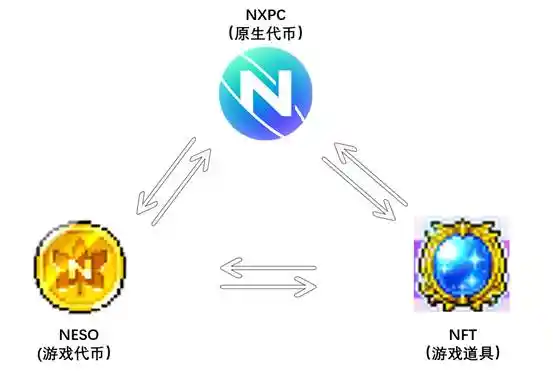
The MSU economy consists of $NXPC, $NESO, and NFT, all of which can be exchanged bidirectionally.
$NXPC - This is both the native token used to pay for MSU Layer1 network gas fees and can be exchanged for $NESO or NFT.
$NESO - Used for various in-game functions (such as weapon enhancement) and can also be exchanged for $NXPC or used to purchase items in the official NFT marketplace.
NFT – In-game items like characters, equipment, and consumables will appear in the form of NFTs, which can be exchanged bidirectionally with $NXPC and traded with $NESO on the official marketplace.
This does not mean that the MSU adopts a dual-token or tri-token model. In fact, the entire economic mechanism is "1 asset with 3 different forms."
If we consider in-game items as a kind of "token," then in the original MapleStory and most MMORPGs, this "token" is somewhat akin to Ethereum—there is no capped supply, it rewards contributors (by dropping items from monsters in the game), and there are channels for burning (low-level items may be consumed through item synthesis, etc.).
The similarity also exists in that in-game items are subject to "network attacks," where the studio's intervention greatly accelerates the generation of in-game items, leading to severe item inflation.
In MSU, all assets originate from $NXPC. The in-game currency $NESO and $NXPC have a fixed exchange rate and can only be minted by exchanging $NXPC. All in-game items (NFTs), such as weapons, armor, and cosmetic items, in MSU are centrally managed by the official team and stored in the official "MSU Item Pool." These items require the use of $NXPC to enter circulation.
In the game, $NESO and in-game items (NFTs) do drop, but this does not mean they are independent assets; their source is also $NXPC:

NESO can only be minted by exchanging NXPC; due to the fixed exchange rate, the theoretical maximum supply of $NESO is the same as that of $NXPC

MapleStory N receives $NXPC as an ecological contribution reward and may exchange some $NXPC for NFTs as in-game rewards, which players can obtain through various in-game activities such as hunting monsters and bosses
It can be said that $NXPC is like liquid water, while $NESO is like ubiquitous water vapor, needed in all aspects of the game, especially in enhancing weapons to help players improve their combat power for better monster hunting, leveling up, and item acquisition in the game. NFTs, on the other hand, are like solid ice, with lower liquidity compared to FTs, and as weapons are enhanced, the prices of the same equipment may differ.
"$NXPC Splitting" and "Item Fusion"
The "$NXPC Splitting" mechanism refers to players being able to use $NXPC to exchange for in-game items (NFTs). This mechanism is similar to a FCFS (First-Come, First-Served) process of purchasing NFTs, where players do not exchange for a specific item but rather a fixed percentage of the maximum supply of all available item types remaining in the "MSU Item Pool."
The exchange rate between $NXPC and NFT will be fixed, and the rate will only increase when new items are introduced in future game updates and enter the "MSU Item Pool." Exchanging NFTs will not result in the destruction of $$NXPC.
The "Item Fusion" mechanism is somewhat like an NFT market having a Bid Pool. If a player wants to quickly sell their item (NFT), they can directly sell it to the pool. However, players do not choose the bid price themselves on the official market; instead, they receive their earnings in the in-game currency $NESO. The official system will fetch the corresponding item prices from the secondary market and determine how much $NXPC the player will receive based on the weighted average price's median.
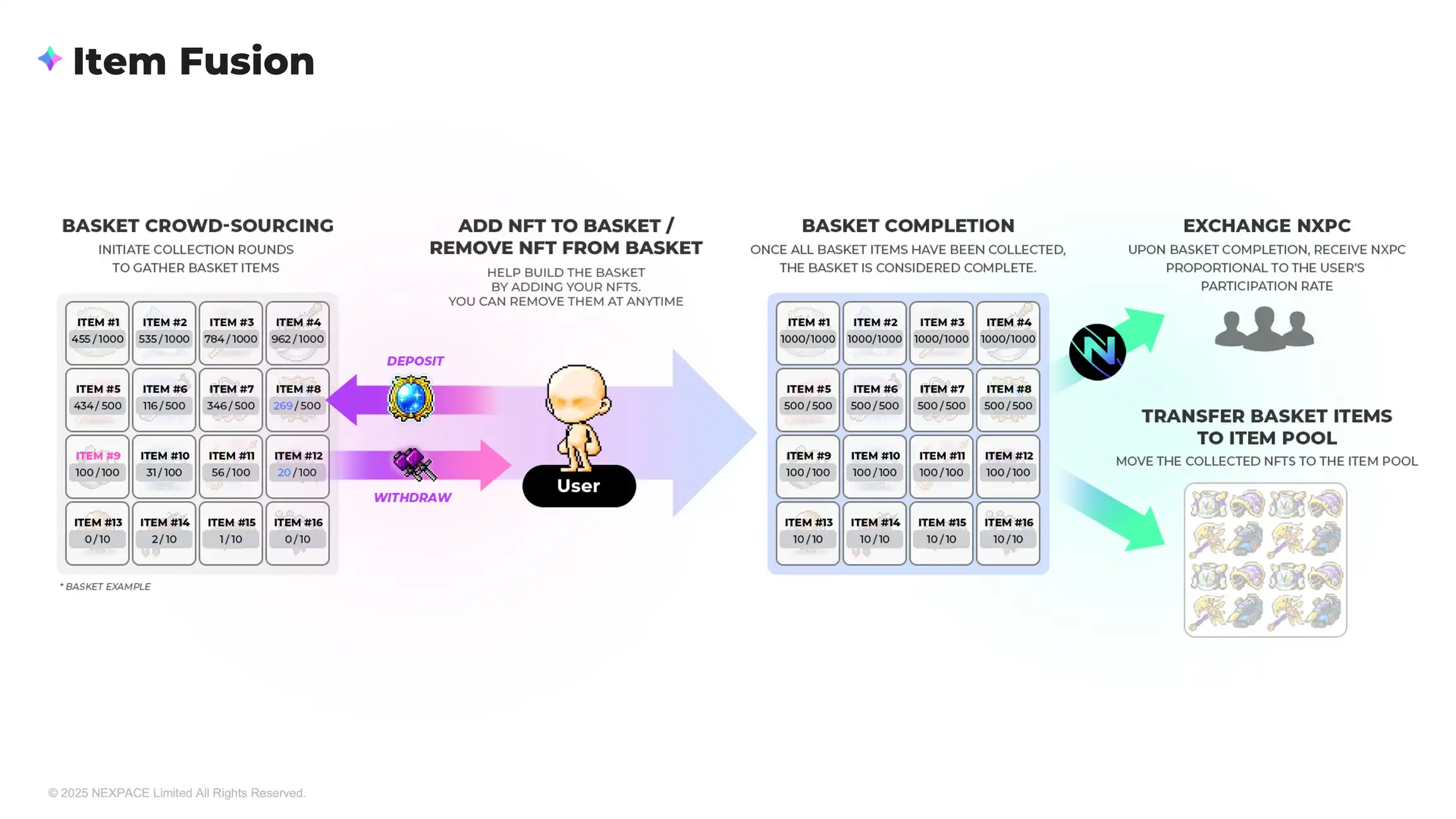
These two mechanisms make the whole game have a strong "GameFi" flavor. In fact, the blockchain version of MapleStory may not have an in-game store or a traditional "NX Cash Shop." Instead, there will be a unified consumption asset, $NXPC—either used for item exchange or converted to $NESO to purchase items on the official NFT market (this is more likely to occur with enhanced premium items with better attributes).
When using $NXPC to exchange items, players will be required to purchase items they do not need. This has the benefit of promoting overall item liquidity (such as items for unpopular classes, low-rarity items, and low-attribute items).
The ideal effect is a "left foot stepping on the right foot"—players use $NXPC to exchange items to enhance the efficiency of obtaining advanced items in the game -> $NXPC price rises -> Returns from "Item Fusion" (gold farming) increase -> More $NXPC buy orders reinvested in gold farming.
However, the expected downside is that the strong "GameFi" flavor may cause a certain degree of attenuation in the game's inherent fun and diversity. Because of the value anchor of $NXPC and the unique characteristics of blockchain users, even with special mechanisms like "NXPC Splitting" to avoid extreme hype around specific items and prevent most items from being worthless, players may still choose the easiest path to maximize $NXPC gains. Many maps, quests, and dungeons that offer low efficiency in terms of leveling or gameplay may be overlooked, affecting the game's diversity. If the "Item Fusion" mechanism is monopolized by the studio, it could likely lead to overall weak consumer spending in the game.
Nevertheless, from a gaming revenue perspective, this is indeed a very bold attempt. MapleStory, originally based its revenue on in-game sales of outfits, enhancement scrolls, and other in-game items to make money, but this blockchain version has no in-game purchases at all, with everything relying on the value of $NXPC. The in-game gold ($NESO) and items (NFTs) are also regulated by $NXPC.
$NXPC
The total supply of $NXPC is 1 billion tokens. 80% is allocated for MSU ecosystem contribution rewards. Of the remaining 20%, 16.317% is airdropped to the early community, 0.437% is used for liquidity providing, 0.15% is used for Gas fee exemption, and a total of 16.904% is fully unlocked at TGE.
Of the remaining 3.096%, 2% goes to the IP rights holder, 0.696% to the MSU team, both locked for 9 months and vested quarterly for 3 years after the lock-up period. 0.4% goes to advisors, locked for 12 months, with unlocking subject to project development progress.
Conclusion
Since the emergence of GameFi, the discussion about the blend of gaming and finance has never ceased. If a truly good game appears in the crypto space, will GameFi break out of its death spiral? This question, MapleStory may provide an answer through its performance.
Furthermore, as MapleStory is an MMORPG game that focuses more on social fun> exploration fun (solely personal opinion), when the audience shifts to one primarily in the crypto space (blockchain special edition), will the game's social fun and the resulting strong virality through community-driven growth change? This question equally makes me very curious and looking forward to it.
But undoubtedly, this is indeed a good game that can make the crypto space happier.
You may also like

The large models in the United States are moving towards closure in the name of security

Morning Report | CoinEx becomes a key hub for Iran to evade sanctions, involving over $3.8 billion in funds; Kalshi seeks a new round of financing, with a valuation potentially rising to $40 billion

From the white-haired stock god to the billionaire fund mogul, the smart people shorting Nvidia are all getting rich using the same framework

Why do cryptocurrency projects always like to change their names?

Global Launch: As predictions become the most scarce asset in the AI era, Manadia is defining the next generation of the value internet

Who is footing the bill for the $64 billion accounting frenzy?
I never expected that the first application of AI x Crypto would be in security auditing

What is your view on Binance's competitive advantages?

ETH has entered a non-consensus phase, and the turning point is approaching!
The shift in the cloud of the air: from despising stablecoins a year ago to the high-profile entry of capital today
The survival dilemma of small and medium exchanges behind the withdrawal anomalies exposed by AscendEX
Why Is Bitcoin Falling Below $60K? 5 Key Market Drivers Explained
Bitcoin has dropped sharply amid ETF outflows, Strategy stock weakness, AI stock rallies, and changing Fed expectations. Explore the key forces driving BTC’s latest correction and what traders should watch next.

Bitcoin vs. Gold in 2026: Which Asset Performs Better in Different Markets?

Morning News | The draft amendment to the People's Bank of China Law aims to clarify the legal status of digital renminbi; South Korea will transfer about 40 unregistered virtual asset service providers to law enforcement agencies
The cryptocurrency industry has entered the "Show Me" era: merely relying on vision is no longer enough

Interpreting the Ethereum Foundation's new structure: Reaffirming self-sovereignty amid institutional trends
Former SpaceX engineer reconstructs the financial execution system using first principles
Standard Chartered Bank sings a 50x rhapsody again, aiming for AAVE to reach 3500 USD
The large models in the United States are moving towards closure in the name of security
Morning Report | CoinEx becomes a key hub for Iran to evade sanctions, involving over $3.8 billion in funds; Kalshi seeks a new round of financing, with a valuation potentially rising to $40 billion
From the white-haired stock god to the billionaire fund mogul, the smart people shorting Nvidia are all getting rich using the same framework
Why do cryptocurrency projects always like to change their names?
Global Launch: As predictions become the most scarce asset in the AI era, Manadia is defining the next generation of the value internet
Who is footing the bill for the $64 billion accounting frenzy?


