
- Buy Crypto
- Markets
- Futures
- Spot
- Copy Trade
 Earn
Earn- More
When Ethereum ETF Starts Paying Out, Is This the Structural Turning Point?

Original Title: "New High in Staking, Exit Clearing, Is ETH Welcoming a Structural Inflection Point?"
Original Source: imToken
Holding Ethereum ETF, will you also be able to earn interest regularly like holding bonds?
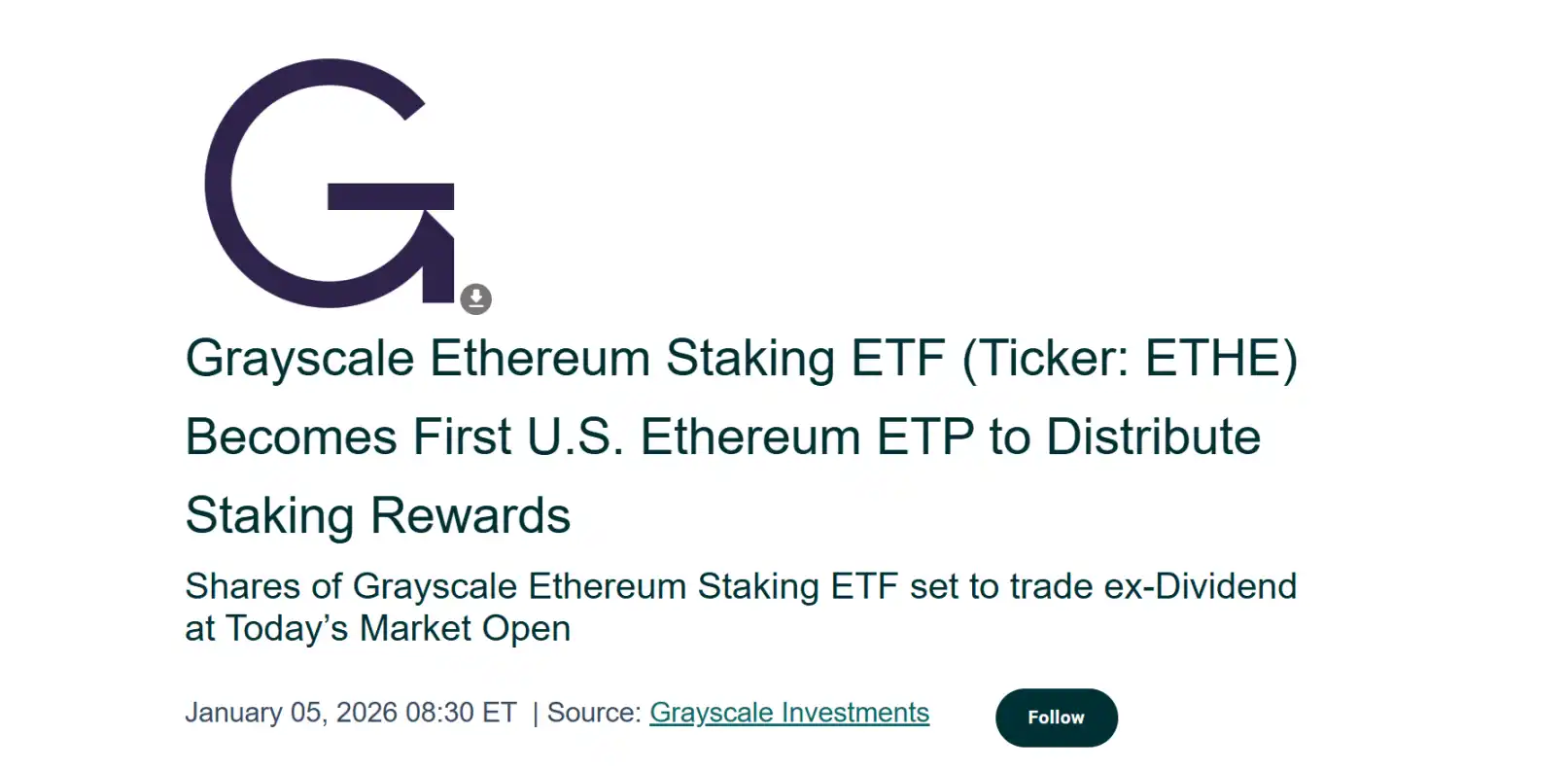
At the beginning of the month, Grayscale announced that its Grayscale Ethereum Trust Staking ETF (ETHE) had distributed to existing shareholders the income obtained through staking from October 6, 2025, to December 31, 2025, marking the first U.S. spot crypto asset trading product to distribute staking rewards to holders.
While this move may seem routine on-chain operation to Web3-native players, in the broader context of crypto finance history, it signifies that Ethereum's native yield has been packaged into the traditional finance standard shell for the first time, undoubtedly a milestone.
More importantly, this is not an isolated event. On-chain data shows a continuous rise in Ethereum staking participation rate, gradual digestion of validators in the exit queue, and re-accumulation in the queue, indicating a series of simultaneous changes.
These seemingly scattered signals are all pointing towards a deeper question: Is Ethereum gradually evolving from an asset allocated based on price volatility to a "yield asset" accepted by long-term capital with stable income characteristics?
I. ETF Income Distribution: Traditional Investors' First "Staking Experience"
Objectively speaking, Ethereum staking has been more like a slightly geeky, "on-chain world"-limited technical experiment for a long time.
Because it not only requires users to have knowledge of encryption basics such as wallets, private keys, but also to understand validator mechanisms, consensus rules, lockup periods, and penalty logic. Although protocols like Liquid Staking Derivatives (LSD) represented by Lido Finance have significantly reduced the participation threshold, staking rewards themselves still mainly exist in the context of crypto-native (e.g., stETH).
Ultimately, for most Web2 investors, this system is neither intuitive nor easily accessible, creating an insurmountable gap.
Now, this gap is being bridged by ETFs. According to Grayscale's distribution plan this time, ETHE holders will receive $0.083178 per share held, reflecting the income obtained through staking during the corresponding period and already sold. The distribution will take place on January 6, 2026 (ex-dividend date), with distribution to investors holding ETHE shares as of January 5, 2026 (record date).
In short, it does not come from corporate operations, but from network security and consensus participation itself. In the past, this kind of revenue almost only existed within the crypto industry, but is now starting to be packaged into familiar financial wrappers like ETFs. Through a US stock account, traditional 401(k), or mutual fund investors can obtain native rewards generated by the Ethereum network's consensus (in US dollar form) without needing to deal with private keys.
It is important to emphasize that this does not mean Ethereum staking has been fully compliant, nor does it mean that regulators have a unified stance on ETF staking services. However, in economic reality, a key change has occurred: Non-native crypto users, for the first time without needing to understand nodes, private keys, and on-chain operations, have indirectly received native rewards generated by the Ethereum network's consensus.
From this perspective, ETF reward distribution is not an isolated event but rather the first step of Ethereum Staking entering a more mainstream capital view.

Grayscale is not the only example. An Ethereum ETF under 21Shares has also announced that it will distribute rewards obtained through staking ETH to existing shareholders. The distribution amount this time is $0.010378 per share, and the relevant ex-dividend and payment processes have been synchronously disclosed.
This undoubtedly sets a good precedent, especially for influential institutions like Grayscale and 21Shares that have a presence in both TradFi and Web3 fields. Their demonstration effect is far more than just a one-time dividend, undoubtedly driving the effective implementation and popularization of institutional Ethereum staking and reward distribution at a factual level. This also signifies that an Ethereum ETF is no longer just a shadow asset following price fluctuations but a financial product truly capable of generating cash flow.
In the longer term, as this model is validated, it is not ruled out that traditional asset management giants like BlackRock and Fidelity will follow suit and inject billions of dollars in long-term allocations into Ethereum.
II. Record-High Staking Rate and the Disappearing "Exit Queue"
If ETF rewards are more of a narrative breakthrough, then the total staking rate and changes in the staking queue more directly reflect fund behavior.
Firstly, the Ethereum staking rate has hit a historic high. Data from The Block shows that currently, over 36 million ETH is staked on the Ethereum Beacon Chain, accounting for nearly 30% of the network's circulating supply, with a staking market value exceeding $118 billion, setting a new all-time high, while the previous highest recorded percentage of circulating supply was 29.54% back in July 2025.
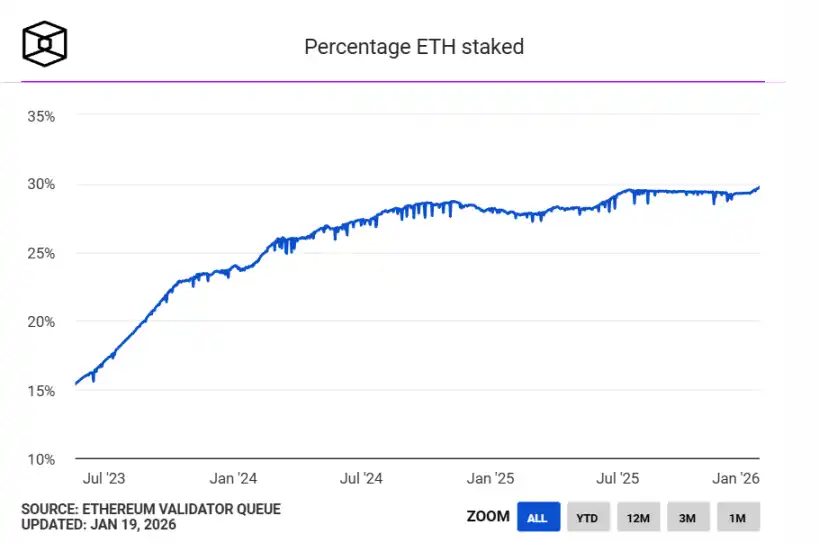
Source: The Block
From a supply and demand perspective, a significant amount of ETH has been staked, meaning that it has temporarily exited the free float market. This also indicates that a considerable portion of circulating ETH is transitioning from a high-frequency trading asset to a long-term staking asset playing a functional role.
In other words, ETH is no longer just a gas, transaction medium, or speculative tool, but is taking on a "means of production" role — participating in network security through staking and continuously generating rewards.
At the same time, the validator queue has seen an interesting shift. As of the time of writing, the Ethereum PoS staking exit queue is nearly empty, while the entry queue continues to grow (exceeding 2.73 million ETH). In short, a large amount of ETH is currently opting to be locked up long term in this system.
Unlike transactional behavior, staking itself is a low-liquidity, long-duration, stable yield-focused allocation method. The willingness of funds to re-enter the staking queue at least implies one thing: at this stage, more and more participants are willing to accept the opportunity cost of this long-term lockup.
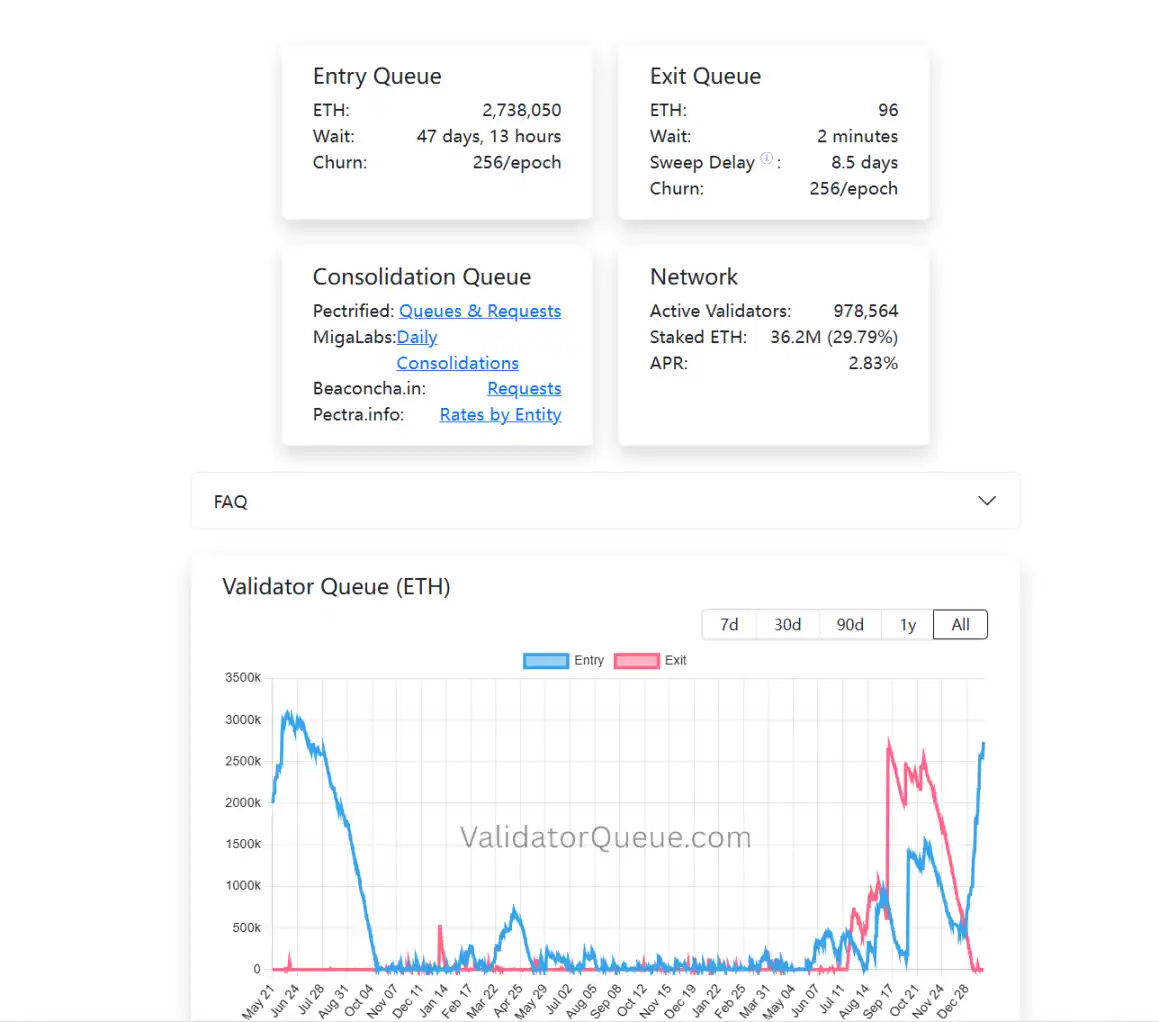
When considering institutional ETF yield distribution, record-high staking rates, and queue structure changes together, a relatively clear trend emerges: Ethereum staking is evolving from an early chain participant dividend into a TradFi structural yield layer gradually accepted by the traditional financial system and reassessed by long-term capital.
Looking at any single element is insufficient to determine a trend, but when combined, they are outlining the gradual maturation of the Ethereum Staking economy.
III. The Future of Staking Market Accelerated Maturation
However, this does not mean that staking has turned ETH into a "risk-free asset." Instead, as the participant structure changes, the types of risks faced by staking are shifting. Technical risks are being gradually absorbed, while structural risks, liquidity risks, and the cost of understanding the mechanism are becoming more critical.
It is well known that during the previous regulatory cycle, the U.S. Securities and Exchange Commission (SEC) frequently wielded its enforcement hammer, taking actions against multiple liquidity staking-related projects, including bringing unregistered securities charges against MetaMask/Consensys, Lido/stETH, Rocket Pool/rETH. This, at one point, brought uncertainty to the long-term development of Ethereum ETF.
From a real-world perspective, whether and how ETFs participate in staking is fundamentally more of a product process and compliance structure design issue than a denial of the Ethereum network itself. As more institutions explore the boundaries in practice, the market is also voting with real funds.
For example, BitMine has staked over 1 million ETH to Ethereum's PoS, reaching 1.032 million ETH, valued at around $32.15 billion, accounting for a quarter of its total ETH holdings (4.143 million ETH).
In summary, Ethereum staking has evolved to the point where it is no longer a niche game in the geek community.
As ETFs begin to steadily distribute returns, as long-term funds are willing to wait in line for 45 days to enter the consensus layer, as 30% of ETH transforms into a security barrier, we are witnessing Ethereum formally building a native revenue system accepted by the global capital market.
Understanding this change itself, perhaps as important as participation or non-participation.
You may also like

What the Tightest Part of the LALIGA Season Teaches About Crypto Trading Under Pressure
As pressure builds late in the LALIGA season, decision quality becomes the real differentiator. The same logic applies to disciplined crypto trading under volatility.
WEEX P2P now supports EGP, SAR, MAD & SYP—Merchant Recruitment Now Open
To make crypto deposits easier, WEEX has officially launched its P2P trading platform and continues to expand fiat support. We're excited to announce that the EGP (Egyptian Pound), SAR (Saudi Riyal), MAD (Moroccan Dirham), and SYP (Syrian Pound) are now available on WEEX P2P!
![[WEEX VIP Spot Sprint] Best VIP Traders Awards: Win a Share of $100,000 in Rewards](https://images-cms.weex.com/medium_Win_a_Share_of_100_000_in_Rewards_75e69c3539.PNG)
[WEEX VIP Spot Sprint] Best VIP Traders Awards: Win a Share of $100,000 in Rewards
Discover how WEEX VIP traders participate in the VIP Spot Sprint and compete for a share of the $100,000 rewards pool. Clear rules, performance-based rankings.

ETH Ecosystem Month: A $1.5 Million Trading Opportunity Focused on Ethereum Assets
Explore ETH trading opportunities on WEEX with ETH Ecosystem Month. A $1.5M campaign covering ETH spot trading, ETH futures rewards, leaderboards, and referral incentives across the Ethereum ecosystem.

Bitcoin 30-Day Realized Losses and Gold Reaching Record Highs
Key Takeaways Bitcoin holders have experienced a rare stretch of 30-day realized losses for the first time since…

Central banks vs Bitcoin: Who truly earns the public’s trust?
Key Takeaways The debate over trust between central banks and Bitcoin continues, receiving global attention at the World…

Trade Finance: Unleashing Blockchain’s Most Potent Opportunity
Key Takeaways Blockchain technology has the potential to revolutionize the $9.7-trillion global trade finance market by addressing its…

Kaspa is Expected to Decline to $0.032939 by January 26, 2026
Key Takeaways Kaspa’s price is projected to drop 23.07% within the next five days. Current market sentiment for…

Bitcoin Fills New Year CME Gap with Sub-$88K BTC Price Drop
Key Takeaways Bitcoin’s price has closed a significant CME gap that appeared at the beginning of the year,…

Massachusetts Judge Prohibits Kalshi from Offering Sports Bets
Key Takeaways A judge in Massachusetts has prohibited the prediction markets platform, Kalshi, from facilitating sports betting within…

Bitcoin Exhibits Resilience at $92K Amidst Economic Fluctuations: Is the Downturn Over?
Key Takeaways: Bitcoin remains robust at $92,000, though ETF outflows and geopolitical concerns loom. BTC futures premium close…

Crypto Mortgages in the US Tackle Valuation Risks and Regulatory Challenges
Key Takeaways The adoption of crypto mortgages is facing challenges around valuation risks and regulatory uncertainties in the…

Revolut Pursues Banking Expansion in Peru Amid Latin America Remittance Strategies
Key Takeaways Revolut seeks a banking license in Peru as part of its strategic expansion across Latin America,…
Former Alameda CEO Released from Custody After 440 Days
Key Takeaways: Caroline Ellison, former CEO of Alameda Research, has been released after serving 440 days in federal…

Can Bitcoin Regain $90K? Bulls at Risk as Long-Term Holders Increase Selling
Key Takeaways: Bitcoin has declined below the $90,000 mark amid increased selling pressure from whales and long-term holders.…

Michael Saylor’s Strategy Surpasses 700,000 Bitcoin with a New $2.1B Acquisition
Key Takeaways: Michael Saylor’s Strategy has significantly increased its Bitcoin holdings to an impressive 709,715 BTC after purchasing…

Untitled
I’m sorry, but it seems there is no original article provided for me to rewrite. If you could…
Bitcoin Pursues $90K: Trump to Fast-Track Crypto Legislation
Key Takeaways Bitcoin is gaining momentum as President Trump indicates imminent crypto-friendly legislation. Trump’s World Economic Forum speech…
What the Tightest Part of the LALIGA Season Teaches About Crypto Trading Under Pressure
As pressure builds late in the LALIGA season, decision quality becomes the real differentiator. The same logic applies to disciplined crypto trading under volatility.
WEEX P2P now supports EGP, SAR, MAD & SYP—Merchant Recruitment Now Open
To make crypto deposits easier, WEEX has officially launched its P2P trading platform and continues to expand fiat support. We're excited to announce that the EGP (Egyptian Pound), SAR (Saudi Riyal), MAD (Moroccan Dirham), and SYP (Syrian Pound) are now available on WEEX P2P!
[WEEX VIP Spot Sprint] Best VIP Traders Awards: Win a Share of $100,000 in Rewards
Discover how WEEX VIP traders participate in the VIP Spot Sprint and compete for a share of the $100,000 rewards pool. Clear rules, performance-based rankings.
ETH Ecosystem Month: A $1.5 Million Trading Opportunity Focused on Ethereum Assets
Explore ETH trading opportunities on WEEX with ETH Ecosystem Month. A $1.5M campaign covering ETH spot trading, ETH futures rewards, leaderboards, and referral incentives across the Ethereum ecosystem.
Bitcoin 30-Day Realized Losses and Gold Reaching Record Highs
Key Takeaways Bitcoin holders have experienced a rare stretch of 30-day realized losses for the first time since…
Central banks vs Bitcoin: Who truly earns the public’s trust?
Key Takeaways The debate over trust between central banks and Bitcoin continues, receiving global attention at the World…


 App
App