Crypto Remittances: How to Send and Receive Money in Latin America

In an increasingly digitized world, crypto remittances are transforming the way millions of people in Latin America send and receive money. With the rise of cryptocurrencies, especially stablecoins and assets like XRP, international transfers have become faster, more economical, and more accessible, challenging traditional methods like Western Union and bank transfers. In this article, we will explore how cryptocurrencies are revolutionizing remittances, with a focus on their impact in countries like El Salvador and Venezuela, and we will offer a step-by-step guide to sending and receiving money using crypto platforms, such as the WEEX exchange.
What are crypto remittances and why are they useful in Latin America?
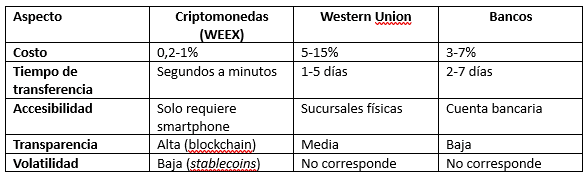
Remittances are money transfers that migrants send to their home countries, and they constitute a key economic pillar in Latin America. According to BBVA Research, in 2024, remittances in the region reached 160.9 billion dollars, which represents up to 26% of the GDP in countries like El Salvador and Guatemala. However, traditional methods, such as Western Union or bank transfers, are often expensive (with fees that can reach 7-15%) and slow, in addition to having waiting times of up to several days.
The cryptocurrencies, especially stablecoins (such as USDT and USDC) and XRP, offer an efficient alternative. Stablecoins have parity with fiat currencies like the dollar, which guarantees the stability of their value, while the XRP token, designed by Ripple, optimizes cross-border transactions with processing times of seconds and minimal costs. These characteristics make the aforementioned options ideal tools for remittances, especially in regions with hyperinflation, like Venezuela, or where crypto adoption is official, as in El Salvador.
Benefits of crypto remittances
- Reduced costs: Cryptocurrency fees are usually a fraction of those of traditional methods. For example, sending $200 to El Salvador through Western Union can cost between $9 and $18, while with cryptocurrencies, the costs can be less than $1.
- Speed: Crypto transfers are almost instantaneous, unlike the days that bank transfers can take.
- Accessibility: In regions with low levels of financial inclusion, where more than 50% of the population does not have a bank account (such as in Mexico), cryptocurrencies allow operating with just a smartphone.
- Stability: Stablecoins avoid the volatility that is usually associated with cryptocurrencies like Bitcoin, ensuring that the transferred value remains constant.
- Transparency and security: Blockchain technology guarantees traceability and reduces the risk of fraud.
Use cases: El Salvador and Venezuela
El Salvador: A crypto testing ground
El Salvador became a global benchmark by adopting Bitcoin as legal tender in 2021. The government launched the Chivo wallet, which allows citizens to send and receive remittances in Bitcoin and stablecoins, such as USDC. According to President Nayib Bukele, this initiative could save the country $400 million a year in fees. Although the results have been mixed so far, the adoption of cryptocurrencies facilitated access to financial services for a population where 70% of the inhabitants do not have a bank account.
For example, a Salvadoran migrant in the U.S. can send USDC through an exchange of their choice, and the receiver in El Salvador can convert it to dollars or use it directly in businesses that accept crypto. The high presence of smartphones (81% in the region) facilitates these transactions.
Venezuela: Crypto remittances as a lifeline
In Venezuela, hyperinflation and the collapse of the bolivar drove the massive adoption of stablecoins like USDT. In 2023, crypto remittances sent to the country exceeded $450 million, according to Chainalysis, which represents a vital solution for the 30% of households that depend on these transfers. Platforms like Binance and Crixto allow Venezuelans to receive USDT and convert it to bolivars through P2P services, avoiding the high fees of Western Union (up to 7%) and the shortage of cash foreign currency.
For example, a Venezuelan living in Argentina can send USDT to a relative in Caracas, who uses it to pay for goods and services directly or converts it to bolivars on local platforms. This system created a more functional economy in a context of economic instability. Furthermore, WEEX offers alerts that allow you to follow cryptocurrency news to stay up to date with market sentiment, because although stablecoins maintain their prices stable, the price of Bitcoin does tend to vary and it is advisable to stay well informed.
Step-by-step guide to sending and receiving remittances with crypto
Below, we explain how to send and receive remittances using cryptocurrencies, with a focus on stablecoins (USDT/USDC) and XRP through the exchange WEEX.
Step 1: Choose a reliable exchange
Select a cryptocurrency exchange that operates in your country and offers low fees, a high level of security, and supports stablecoins and XRP. WEEX is an excellent option for users in Latin America due to its user-friendly interface, its low fees (starting from 0.2% per transaction), and its compatibility with local currencies like the Mexican peso, the Argentine peso, and the Venezuelan bolivar.
- Register on WEEX:
- Visit the WEEX registration page and create an account with your email.
- Complete identity verification (KYC) to comply with regulations.
- Enable two-factor authentication (2FA), for example, via Google Authenticator, for greater security.
- Deposit funds:
- Use payment methods such as bank transfers or credit/debit cards to add funds in your local currency.
- WEEX does not charge fees for deposits, which reduces initial costs.
Step 2: Buy stablecoins or XRP
- Buy USDT/USDC or XRP:
- In WEEX, select the corresponding trading pair (for example, USD/USDT for US dollars).
- Buy the desired amount. For example, $200 USD in USDT or XRP, with an average transaction cost of 0.2-0.9%.
- Stablecoins are ideal for avoiding volatility, while XRP is perfect for fast transfers due to its design for cross-border payments.
Step 3: Send the remittance
- Set up a crypto wallet:
- Both the sender and the receiver must have a crypto wallet. Some popular options include Exodus, MetaMask (for stablecoins), or an XRP-compatible wallet like Xaman (formerly Xumm). They can also use the wallet address provided by the exchange of their choice, which speeds up transactions but also reduces security for the user.
- Make sure the receiver's wallet supports the chosen cryptocurrency.
- Transfer the funds:
- In WEEX, select "Withdraw" and choose USDT, USDC, or XRP.
- Enter the receiver's wallet address (an alphanumeric code or QR) and the corresponding network.
- Confirm the transaction. Transfers are usually completed in seconds (XRP) or minutes (USDT/USDC).
Step 4: Receive and convert the remittance
- Receive the funds:
- The receiver will see the funds in their crypto wallet almost immediately.
- In countries like Venezuela, USDT can be used directly in businesses or converted to bolivars through P2P platforms.
- Convert to local currency (Optional):
- In WEEX, the receiver can sell USDT/USDC or XRP for local currency (for example, MXN or ARS) and withdraw the funds to a bank account.
- Note: Conversion fees vary, but they are usually less than 1% on WEEX.
Step 5: Security precautions
- Verify the address: Ensure that the wallet address is correct, as blockchain transactions are irreversible.
- Avoid scams: Use regulated exchanges, such as WEEX, and never share your private keys.
- Check regulations: In some countries, such as Argentina, cryptocurrencies are subject to taxes. Inform yourself about local legislation.
Comparison: Cryptocurrencies versus traditional methods
Challenges and future of crypto remittances
Despite their advantages, crypto remittances face challenges:
- Digital literacy: Learning to set up wallets and understanding how the blockchain works requires a certain technical knowledge.
- Regulations: Although the GENIUS Act in the U.S. clarified the use of stablecoins, in many Latin American countries, the rules are nascent.
- Conversion to cash: Converting cryptocurrencies to local currency can be expensive in rural areas.
However, the future is promising. Companies like Western Union are exploring the integration of stablecoins to reduce costs and speed up transfers. Additionally, exchanges like WEEX are expanding their presence in the region, offering accessible and secure solutions.
Conclusion
Crypto remittances, driven by stablecoins and the XRP token, are revolutionizing the way money is sent and received in Latin America. In countries like El Salvador and Venezuela, these technologies not only reduce costs and times, but also empower unbanked populations. Platforms like WEEX facilitate this process with low fees, a high level of security, and compatibility with local currencies. By following our step-by-step guide, anyone with a smartphone will be able to take advantage of this innovation to send money efficiently and securely.
Are you ready to start? Download the WEEX app, buy USDT or XRP, and start sending remittances without the hurdles of traditional methods. The future of money is already here!
Disclaimer
WEEX and its affiliates provide digital asset exchange services, including derivatives trading and margin trading, only where legal to do so and for eligible users. All content is general information and does not constitute financial advice. You should seek financial advice before trading. Cryptocurrency trading is a high-risk activity and can result in the total loss of your assets. By using WEEX services, you accept all related risks and terms. Never invest more than you can afford to lose. Consult our Terms of Use and our Risk Disclosure for full details.